On-page SEO is one of the most important parts of building a successful website. It helps search engines understand your content while improving the user experience for visitors. No matter if you have a business site, blog, eCommerce store, or portfolio, optimizing your pages boosts your visibility in search results. This helps attract steady organic traffic.
For beginners, on-page SEO might seem technical. However, it mainly improves:
Content
Keywords
Page structure
Internal linking
Images
Overall website usability
Search engines like Google look at these factors. They want to find which pages give the best experience and the most relevant information.
At Smart BrandX, businesses and website owners can learn modern SEO strategies. These strategies help boost rankings, increase traffic, and improve conversions. A strong on-page SEO strategy ensures every page on your website is optimized for both users and search engines.
This beginner’s guide covers “what is on-page SEO?”, its importance, and how to use effective techniques to improve your search rankings.
What Is On-Page SEO?
On-page SEO is the practice of improving individual web pages. This helps them rank higher in search engine results and draw in more relevant traffic.
It focuses on improving:
Content quality
Title tags
Meta descriptions
URL structure
Keyword placement
Internal links
Images
Headings
Page speed
On-page SEO is different from off-page SEO. While off-page SEO looks at backlinks and outside signals, on-page SEO focuses on what you can control on your own website. Search engines look at these elements to see what your content covers. They also check if it meets user intent.
Effective on-page SEO helps search engines crawl and index your pages correctly. It also improves the experience for visitors by making content easier to read, navigate, and understand.
Modern on-page SEO is not just about inserting keywords repeatedly. Search engines now rank relevance, helpfulness, expertise, readability, and user satisfaction. Pages that answer search queries clearly and provide valuable information are more likely to rank higher.
At Smart BrandX, businesses learn to mix content strategy, keyword optimization, and technical upgrades. This helps them create pages that do well in tough search results.
Why Is On-Page SEO Important?
On-page SEO is important because it directly affects how search engines interpret and rank your content. Even the best content may struggle to rank if it is not properly optimized.
Search engines use hundreds of ranking signals to determine which pages deserve top positions. Many signals come from “what is on-page SEO” elements. These include headings, keywords, content quality, page structure, and internal linking.
Strong on-page SEO helps websites:
Improve visibility in search engine results
Increase organic traffic
Enhance user experience
Reduce bounce rates
Increase engagement and conversions
Help search engines understand content better
A properly optimized page also improves accessibility and usability for visitors. Clear headings, easy formatting, quick loading speeds, and helpful content keep users on your site longer. They also encourage more interaction.
On-page SEO is very valuable for small businesses and startups. It provides long-term results and doesn’t depend only on paid ads. Once pages rank well, they can continue generating traffic consistently.
At Smart BrandX, businesses find useful SEO methods. These strategies boost rankings and enhance the user experience.
On-Page SEO vs. Off-Page SEO
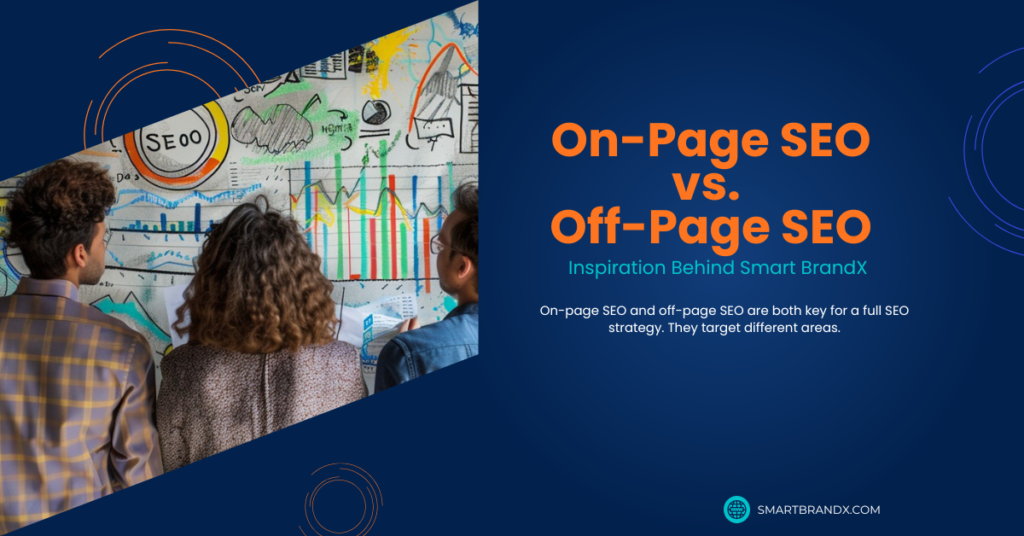
On-page SEO and off-page SEO are both key for a full SEO strategy. They target different areas.
What is On-page SEO refers to optimizations made directly on your website. This means enhancing content, title tags, keywords, internal links, images, headings, and page speed. The goal is to help search engines understand your content while improving user experience.
What is Off-page SEO focuses on activities outside your website that influence authority and trust. The most common example is backlink building. When reputable websites link to your content, search engines see your site as more credible.
Here are the main differences:
On-Page SEO
Off-Page SEO
Focuses on website content
Focuses on external signals
Includes keywords and headings
Includes backlinks and mentions
Improves user experience
Builds website authority
Controlled directly by website owner
Influenced by external websites
Helps search engines understand pages
Helps improve trust and credibility
Both strategies work together. Even if you have high-quality backlinks, weak on-page SEO can prevent pages from ranking effectively. Similarly, excellent on-page optimization may struggle without authority signals.
Smart BrandX helps businesses build balanced SEO strategies. They combine strong on-page optimization with effective off-page techniques.
How to Do On-Page SEO for Your Site: 11-Item Checklist
Successful on-page SEO requires consistency, strategy, and attention to detail. This 11-item checklist highlights key techniques. Use it to boost rankings, increase organic traffic, and enhance user experience.
1: Place Target Keywords & Prompts Strategically
Strategic keyword placement helps search engines understand your page’s topic and relevance. Place keywords in key areas where they fit naturally. Avoid stuffing them unnaturally.
Search engines now focus heavily on semantic relevance and user intent. This means you should also include related phrases, contextual prompts, and long-tail keywords.
Best practices include:
Add your primary keyword in the page title
Include keywords naturally in the introduction
Use related terms throughout the content
Place keywords in headings and subheadings
Add keywords to image alt text where relevant
Include long-tail search phrases naturally
Avoid excessive keyword repetition
Write for users first, not search engines
Use conversational phrases and search prompts
Optimize for voice search queries
Keyword placement should improve clarity rather than disrupt readability. Content that sounds natural performs better for both users and search engines.
At Smart BrandX, businesses discover how to balance keyword optimization and engaging content writing.
2: Write Accurate Title Tags
Title tags are one of the most important what is on-page SEO elements because they tell search engines and users what your page is about. A strong title tag improves visibility and click-through rates.
Your title should clearly describe the page content while encouraging users to click.
Best practices for title tags:
Keep titles under 60 characters
Include your primary keyword near the beginning
Write clear and descriptive titles
Avoid keyword stuffing
Make titles compelling for users
Include numbers or power words when relevant
Ensure every page has a unique title
Match the title with search intent
Use branding strategically
Avoid misleading titles
Example:
Good Title: “What Is On-Page SEO? Beginner’s Guide for Higher Rankings”
Weak Title: “SEO SEO SEO Guide Best SEO”
An optimized title tag improves both search rankings and user engagement.
Smart BrandX emphasizes creating optimized titles that increase visibility while maintaining readability and trust.
3: Optimize Your URL Slugs
URL slugs help search engines, and users understand page topics quickly. Short, descriptive URLs are easier to read, share, and index.
A clean URL structure also improves overall website organization.
Best practices for URL optimization:
Keep URLs short and simple
Include the target keyword naturally
Use hyphens instead of underscores
Avoid random numbers or symbols
Remove unnecessary words
Use lowercase letters only
Make URLs readable for humans
Keep URL structure consistent
Avoid changing URLs frequently
Create logical category structures
Example:
Good URL: example.com/what-is-on-page-seo-guide
Poor URL: example.com/page?id=4567&seo=abc
Optimized URLs improve user trust and search engine understanding.
At Smart BrandX, SEO specialists focus on creating organized website structures that support better crawling and indexing.
4: Write Accurate Meta Descriptions
Meta descriptions summarize page content in search engine results. While they may not directly impact rankings, they strongly influence click-through rates.
A compelling meta description encourages users to visit your page.
Best practices for meta descriptions:
Keep descriptions around 150–160 characters
Include the primary keyword naturally
Clearly summarize the page content
Add a call-to-action when appropriate
Avoid duplicate meta descriptions
Match search intent accurately
Write persuasive copy
Focus on benefits for users
Maintain readability and clarity
Avoid misleading information
Example:
“Find out what is on-page SEO. Explore effective strategies to boost rankings, increase traffic, and enhance user experience.”
Strong meta descriptions help your pages stand out in search results.
Smart BrandX helps businesses make better metadata. This boosts visibility and gets more clicks.
5: Structure Your Content with Headings
Headings organize content into readable sections and help search engines understand page structure.
Well-structured content improves readability, accessibility, and SEO performance.
Best practices for headings:
Use only one H1 per page
Include keywords naturally in headings
Use H2 and H3 tags logically
Keep headings clear and descriptive
Break content into smaller sections
Improve readability with formatting
Match headings with user intent
Avoid keyword stuffing in headings
Make headings informative
Use hierarchy consistently
A strong heading structure allows users to scan content while helping search engines identify key topics.
At Smart BrandX, we focus on clear content strategies. This helps improve readability and structure. As a result, we boost engagement and rankings.
6: Create Unique, Helpful Content
Content quality is one of the most important ranking factors. Search engines prioritize pages that provide valuable, original, and relevant information.
Your content should answer user questions clearly and completely.
Best practices for content creation:
Write original content
Focus on solving user problems
Cover topics comprehensively
Maintain accuracy and relevance
Use simple, readable language
Add examples and practical insights
Update outdated content regularly
Avoid duplicate content
Include semantic keywords naturally
Prioritize user experience
Helpful content builds trust, improves engagement, and increases the likelihood of earning backlinks.
Smart BrandX encourages businesses to create audience-focused content that supports long-term SEO growth.
7: Add Strategic Internal Links
Internal links connect pages on your website. They also help search engines see how your site is organized.
They also guide users toward related content and improve navigation.
Best practices for internal linking:
Link to relevant pages naturally
Use descriptive anchor text
Avoid excessive linking
Connect related blog posts
Link important pages frequently
Help users discover more content
Improve website crawlability
Maintain logical site architecture
Update old pages with new links
Use internal links to reduce bounce rates
Strategic internal linking distributes authority throughout your website and improves indexing.
At Smart BrandX, businesses discover how to create SEO-friendly site structures. They use smart internal linking strategies to boost their visibility.
8: Add External Links to Credible Sources
External links to trustworthy websites help support your claims and improve content credibility.
Search engines value pages that reference authoritative sources.
Best practices for external linking:
Link to trusted websites only
Use relevant sources
Support facts and statistics
Avoid linking to spammy sites
Open external links in new tabs
Keep links updated
Use descriptive anchor text
Add value for readers
Cite industry authorities
Balance internal and external links
Credible references improve user trust and strengthen topical relevance.
Smart BrandX recommends using authoritative sources to enhance content quality and expertise.
9: Write Descriptive Image File Names and Alt Text
Proper image SEO can also increase visibility in image search results.
Best practices for image optimization:
Use descriptive file names
Include relevant keywords naturally
Write accurate alt text
Compress images for faster loading
Use modern image formats
Avoid keyword stuffing
Keep image sizes optimized
Use responsive images
Add captions when useful
Improve accessibility for users
Example:
Good File Name: what-is–on-page-seo-checklist.jpg
Poor File Name: IMG_12345.jpg
Optimized images improve performance, accessibility, and SEO.
Smart BrandX helps businesses improve visual content for search engines and user experience.
10: Optimize for Page Speed
Page speed is a major ranking factor because users expect fast-loading websites.
Slow pages can increase bounce rates and reduce conversions.
Best practices for improving page speed:
Compress images
Use browser caching
Minimize CSS and JavaScript
Reduce unnecessary plugins
Use reliable hosting
Enable lazy loading
Optimize mobile performance
Use content delivery networks (CDNs)
Remove unused code
Test speed regularly
Fast websites improve user satisfaction and search rankings.
At Smart BrandX, we focus on making websites fast and responsive. This helps boost SEO growth.
11: Add Schema Markup
Schema markup is structured data that helps search engines better understand your content.
It can improve visibility through rich results and enhanced SERP features.
Best practices for schema markup:
Add relevant schema types
Use valid structured data
Test the schema regularly
Include FAQ schema when appropriate
Use the article schema for blog posts
Implement local business schema
Avoid misleading markup
Follow Google guidelines
Keep the schema updated
Improve eligibility for rich snippets
Schema markup can help your pages appear with enhanced search features such as star ratings, FAQs, and rich snippets.
Smart BrandX helps businesses use structured data strategies. This boosts visibility and click-through rates.
Measure Your On-Page SEO Success
Tracking performance is essential for understanding whether your SEO strategy is working. Monitoring rankings, traffic, CTR, and SERP visibility helps identify opportunities for improvement.
1: Keyword Positions
Keyword rankings help measure how visible your pages are in search results.
Organic traffic shows how many visitors reach your website through search engines.
Important traffic indicators include:
Total organic visits
Landing page performance
User engagement metrics
Traffic growth trends
Mobile vs. desktop traffic
Geographic traffic sources
Increasing organic traffic usually indicates successful SEO optimization.
3: Click-Through Rate (CTR)
CTR measures how often users click your pages after seeing them in search results.
Ways to improve CTR:
Write stronger title tags
Create compelling meta descriptions
Align the search intent with precision.
Use emotional trigger words
Improve SERP visibility
Optimize structured data
Higher CTR often leads to increased traffic and engagement.
4: SERP Feature Appearances
SERP features increase visibility beyond standard organic listings.
Track appearances in:
Featured snippets
FAQ results
Image packs
Video results
Local packs
Rich snippets
Optimized content and structured data improve your chances of earning SERP features.
5: AI Mentions and Citations
AI-driven search experiences are becoming more important in modern SEO.
Check:
AI-generated search mentions
Citations from authoritative sources
Brand visibility in AI results
Content authority signals
Semantic relevance
User trust indicators
Creating authoritative, high-quality content increases the likelihood of AI citations.
Smart BrandX helps businesses adapt their SEO strategies for evolving AI-powered search environments.
Conclusion
On-page SEO is the foundation of a successful digital marketing strategy. By optimizing content, keywords, metadata, page speed, internal links, and user experience, businesses can improve search rankings and attract more organic traffic.
Modern SEO focuses on creating valuable, user-centered experiences rather than simply inserting keywords. Websites that provide helpful content, strong technical optimization, and clear site structure are more likely to succeed in competitive search results.
At Smart BrandX, businesses can discover practical SEO strategies designed to improve visibility, traffic, and long-term growth. Consistently implementing these on-page SEO techniques can help your website rank higher and achieve sustainable online success.
FAQs (Frequently Asked Questions)
1: What is on-page SEO in simple words?
On-page SEO refers to optimizing the content and structure of your website pages to improve search engine rankings and user experience. Smart BrandX provides beginner-friendly SEO guidance for businesses and website owners.
2: Why is on-page SEO important?
On-page SEO helps search engines understand your content and improves your chances of ranking higher in search results, leading to more organic traffic.
3: What are the most important on-page SEO factors?
Key factors of what is on-page seo include keywords, title tags, meta descriptions, headings, content quality, internal links, page speed, and image optimization.
4: How long does on-page SEO take to show results?
SEO results vary depending on competition and website authority, but many websites begin seeing improvements within a few weeks to several months.
5: Is on-page SEO better than off-page SEO?
Both are important. On-page SEO improves website quality and relevance, while off-page SEO builds authority through backlinks and mentions.
6: How often should I update my on-page SEO?
Regular updates are recommended to keep content accurate, relevant, and aligned with search engine algorithm changes.
7: Can beginners learn what is on-page SEO easily?
Yes. Beginners can learn on-page SEO by understanding keywords, content optimization, headings, metadata, and website structure. Smart BrandX shares practical SEO insights for beginners.
8: Does Smart BrandX provide SEO guidance?
Yes. Smart BrandX offers valuable resources, blogs, and strategies that help businesses improve SEO performance, increase visibility, and grow online.
Imagine putting in effort to make great, SEO-friendly content, then realizing your own pages are competing for the same search terms. This frustrating scenario is known as keyword cannibalization. It happens when several pages on your website aim for the same keyword and search intent. This confuses search engines and can hurt your site’s performance.
When keyword cannibalisation occurs, search engine bots have a hard time determining which page best fits a query. This can cause your best content to go unnoticed. Visitors might end up on less relevant pages, which can lower your search rankings and conversion rates.
We’ll explore why this issue is detrimental to your SEO, how to identify it, and most importantly, how to fix and prevent it.
What Is Keyword Cannibalization?
Keyword cannibalization occurs when multiple pages on a website compete for the same keyword or search intent. These pages don’t work together; they compete in search results. So your own content ends up as a rival.
Think of it like fielding two candidates from the same party in a single-seat election. Both split the votes, and neither wins decisively. In SEO, Google decides which of your pages best fits the query. If it can’t make a clear choice, it may rank both pages lower than they deserve.
This typically occurs when a website:
Publishes multiple blog posts covering the same topic from nearly identical angles
Creates separate category, tag, and product pages that all optimize for the same phrase
Builds landing pages for different campaigns using the same primary keyword
Adds new content over time without auditing what already exists
Cannibalization isn’t always obvious. Two pages may seem to target different keywords, but they can meet the same user intent. From Google’s view, this means they address the same issue.
Why Keyword Cannibalization Matters for Rankings?
Left unaddressed, keyword cannibalization quietly erodes your search performance in several ways.
Split Authority: Backlinks and engagement signals often spread out. Instead of focusing on one strong page, they get shared among competing URLs. Neither page accumulates enough authority to rank at its full potential.
Crawl budget waste: Search engines allocate a finite crawl budget to each site. Cannibalized pages make crawlers waste time on duplicate content. This reduces resources for your most valuable pages.
Volatile rankings: Google can switch between URLs in the SERPs. This means your ranking may change unexpectedly. It’s not always due to algorithm updates, but rather Google deciding which page to display.
Lower click-through rates: When the “wrong” page ranks, like an old post or a thin category page, users see a less appealing result. They click less, and even when they do, the landing experience may not match their intent.
Diluted internal linking: If there’s no clear canonical page, your internal links scatter across many URLs. This weakens the signal to Google about which page you think is most important.
The good news: keyword cannibalization is fixable. Once you identify the issue, you can fix it. Use consolidation, canonical tags, redirects, or clear content differences. These methods help your pages work together instead of competing.
What Are Examples of Keyword Cannibalization?
Keyword cannibalization occurs when several pages on your site target the same search query. This splits authority and confuses search engines about which page to rank. Here are two of the most common scenarios where this plays out.
1: Blog Content Overlap
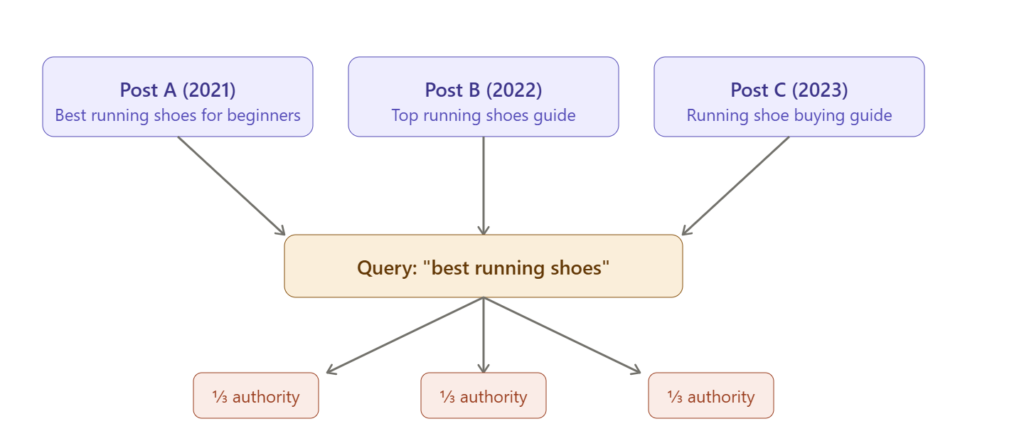
Editorial sites often accumulate this problem over time. A team publishes a post on “best running shoes for beginners” in 2021. Then, they created a “top running shoes guide” in 2023. Finally, they add a roundup called “running shoe buying guide.” Each targets a similar goal, so Google must decide which one gets the top spot. Often, it rotates between them or ranks none well.
The solution is simple: consolidate. Choose the strongest post, redirect the others to it, and combine any unique value from the weaker posts into the main one.
2: E-commerce Category Conflicts
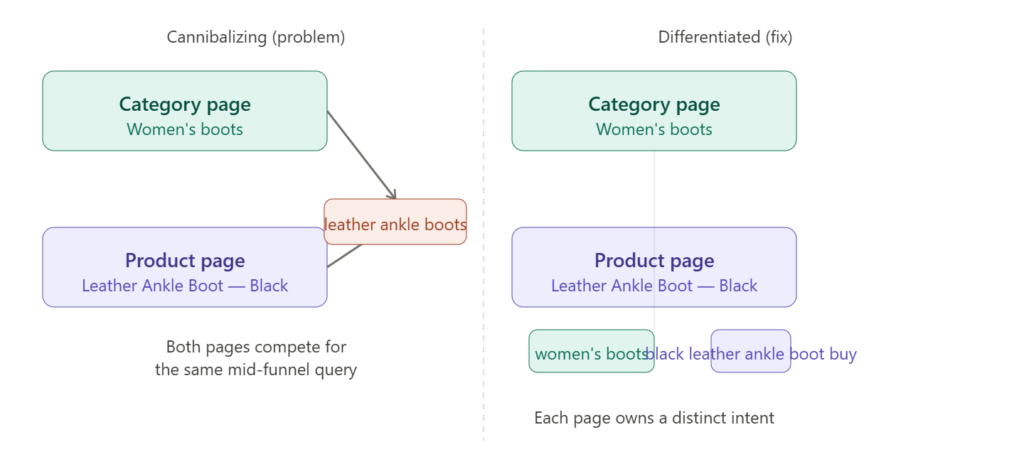
Online stores run into a different version of the same problem. A “women’s boots” category page and a product page for “leather ankle boots” compete for attention. The category page should target broad, high-volume terms. The product page should focus on specific, long-tail terms. When the targeting overlaps, neither ranks as well as it could.
The solution is intent mapping. Category pages should focus on broad queries like “women’s boots.” Product pages should target specific, buy-intent terms such as “black leather ankle boot size 8.” Clear separation means each page sends a stronger, unambiguous signal to search engines.
How to Find Cannibalized Keywords?
Keyword cannibalization occurs when several pages on your site target the same keyword. This splits authority and confuses search engines about which page should rank.
1: Using Google Search Console
GSC is the most reliable free method since it shows you actual ranking data directly from Google.
Step 1: Run a query filter. Go to Performance → Search Results. Click + New and filter by a specific query, like “content marketing.” GSC will show every URL on your site ranking for that term.
Step 2: Check for several URLs with the same query. Stay on the Pages tab and keep your query filter on. If you see 2+ different URLs appearing for the same keyword, that’s a cannibalization signal.
Step 3: Check the Clicks/Impressions split. If two pages share impressions for the same query—like 60/40 or 50/50—neither page holds full authority. A healthy pattern is one dominant page capturing the bulk of impressions.
Step 4: Use the date comparison feature. Compare two time periods to see rank changes. If your ranking URL keeps switching between two pages, cannibalization is likely the cause.
Key sign of cannibalization in GSC: A keyword has high impressions but low clicks. Also, the ranking URL changes often in reports.
2: SEO Tools and Manual Methods
Semrush / Ahrefs (Most Efficient)
Use the Position Tracking tool. Add your target keywords. Then, check for the same keyword linked to different URLs over time.
In Ahrefs, go to Site Explorer. Then choose Organic Keywords. Export the data. Next, filter in Excel or Sheets for keywords that show up on multiple pages.
Semrush offers a Cannibalization Report in Position Tracking. It automatically flags conflicting pages
Screaming Frog
Crawl your site and export all page titles and H1S. Then check for pages that have similar or overlapping topics. This can signal structural cannibalization.
It shows pages where the keyword is in the title tag. This is the clearest sign of intentional optimization overlap.
4: Spreadsheet Audit Method
Export all your URLs + their primary target keywords from your SEO tool or a content inventory
Sort by keyword in a spreadsheet
Review any keyword that appears on many rows with different URLs for cannibalization.
To fix cannibalized keywords, you can:
Consolidate pages
Set canonical tags
Use 301 redirects to the stronger page
Clearly define each page’s search intent
Common Causes of Keyword Cannibalization
Keyword cannibalization rarely happens by design. It usually stems from three main problems: fragmented content planning, unintentional content overlap, or overly aggressive on-page SEO.
1: Poor Content Planning
Most keyword cannibalization problems trace back to a lack of strategic content planning. When different teams or writers publish content on their own, they often overlap. This happens because they don’t see what others have done. As a result, similar topics get covered again and again.
Common planning failures include:
No centralized content calendar or topic registry
Multiple writers assigned similar topics without coordination
Blog posts and landing pages targeting the same keyword
Product, category, and tag pages are all optimized for identical terms
Good content keyword strategies can still cause cannibalization if you don’t know what’s published. You need to check which keywords those pages use.
2: Duplicate or Similar Content
Similar topics handled in the same way can still cause cannibalization, even if the content isn’t identical. Search engines look at content as a whole. If two pages discuss the same topic similarly, they will compete. This is true even if the text isn’t unique.
Typical scenarios include:
Blog posts published months apart covering the same how-to topic
An evergreen guide and a recent news article addressing identical queries
Service pages and case study pages optimized for the same service keyword
E-commerce category pages and brand pages targeting identical product terms
The result is that Google must make a judgment call about which page to surface — and it may choose inconsistently, rotate between pages, or rank neither as highly as a single consolidated page would rank.
3: Over-Optimization of Keywords
Aggressive keyword optimization can inadvertently pull unrelated pages into competition. When site-wide elements like navigation labels, footers, sidebar links, and template headings are filled with a target keyword, it can confuse search signals. This affects pages that weren’t meant to rank for that term.
Over-optimization patterns that cause cannibalization:
Forcing the same primary keyword into the title tags of multiple pages
Using identical or near-identical meta descriptions across similar pages
Adding keyword-rich anchor text in the global navigation pointing to multiple pages
Creating location or variation pages that are thinly differentiated and keyword-stuffed
How to Fix Keyword Cannibalization? Simple Guide
To fix keyword cannibalization, first, find the pages that compete. Then, choose the best solution based on their relationship. There are three primary solutions: consolidation, technical signals, and improved internal linking.
1: Content Consolidation
When two or more pages cover the same topic well, it’s best to merge them. This creates a stronger, more authoritative resource. Consolidation combines link equity, topical signals, and engagement metrics into one URL. This often leads to a big boost in ranking for the page that remains.
How to consolidate effectively:
Identify all cannibalizing pages using a rank tracker, Search Console, or a keyword mapping audit.
Identify the “winner.” This is usually the page with the most backlinks, best average position, or highest user engagement.
Migrate unique, high-quality content from the losing pages into the winner.
Redirect all losing URLs to the consolidated page.
Update all internal links site-wide to point to the new canonical URL.
2: Redirects and Canonical Tags
When pages need to stay live for users or business, but shouldn’t compete in search, use technical signals. These signals tell search engines which version to prioritize.
301 Redirects: A permanent 301 redirect passes link equity from the old URL to the destination and removes the old page from the index. Use 301s when the old page has no ongoing user value, and merging is feasible.
Canonical Tags: A canonical tag (rel=”canonical”) signals to Google which version of a page is the preferred one without removing the other URL. It’s okay to keep the non-canonical page accessible. For example, this includes a printer-friendly version, paginated results, or a session-URL variant.
Important: Canonical tags are a hint, not a directive. If the non-canonical page receives significant backlinks or engagement, Google may ignore the tag. In those cases, a 301 redirect is the stronger solution.
3: Internal Linking Strategy
Internal linking is one of the most underused signals for resolving cannibalization. Linking to your preferred page with keyword-rich anchor text helps search engines. Avoid linking to competing pages with the same anchors. This way, search engines know which URL to rank for a specific query.
Internal linking best practices for resolving cannibalization:
Identify your canonical page for each target keyword and make it the default link destination site-wide.
Audit existing internal links to remove or update anchors that point competing pages toward the same keyword.
Use a hub-and-spoke model: one pillar page per topic cluster, supported by subtopic pages that link back to it.
Avoid identical anchor text pointing to multiple different pages from the same piece of content.
Addressing Keyword Cannibalization Proactively
Fixing cannibalization after the fact is costly and time-consuming. The most effective approach is building systems that prevent it from occurring. Two practices are central: keyword mapping and regular content audits.
1: Keyword Mapping Strategy
A keyword map is a document that links target keywords to specific pages on your site. This way, each keyword has one clear owner. It becomes the single source of truth for your entire content team.
Building an effective keyword map:
Gather all URLs along with their main keywords. You can find this in Search Console under Performance, then Pages.
Add your target keyword list and assign each keyword to the most appropriate existing or planned page.
Flag any keyword assigned to more than one page — these are your cannibalization risks.
Integrate the map into your workflow. Before you commission new content, writers and editors should check the map. This ensures the target keyword isn’t already taken.
Update the map whenever a new page is published, an old page is redirected, or a keyword strategy changes.
A keyword map doesn’t have to be complex. A simple spreadsheet works well. Just include the URL, primary keyword, secondary keywords, and the last-reviewed date. This is enough for most sites.
2: Content Audits and Maintenance
Even with a keyword map in place, cannibalization can creep in over time — especially as content is updated, repurposed, or expanded. Regular content audits catch these issues before they compound.
A practical content audit cadence:
Quarterly: Use a rank tracker or Google Search Console’s Performance report to check for cannibalization. Look for multiple URLs ranking on page one or two for the same query.
Bi-annually: Review your keyword map against all published URLs. Flag any page that has drifted from its originally assigned keyword through content updates.
Before big publishing pushes, always check the planned URLs against the keyword map. Do this before you launch a content series or campaign.
After a site migration or redesign, changes to URLs, site structure, and templates can cause cannibalization. Audit immediately post-launch.
Tools like Screaming Frog, Ahrefs Site Audit, Semrush’s Position Tracking, and Google Search Console can quickly spot cannibalization signals. They work well at scale.
Conclusion
Keyword cannibalization is a structural problem that gradually worsens over time. Ignoring this weakens the authority of key pages. It confuses search engines and creates a disjointed user experience. The good news is that it’s both fixable and preventable with the right systems.
Start with a diagnostic: map your existing URLs to their keywords and identify where competition exists.
Apply the right remedy:
Consolidate when you can.
Use technical signals when needed.
Tighten internal links to boost key pages.
Investing in a well-kept keyword map and regular audits will prevent cannibalization from coming back. The sites that rank well don’t always have the most content. Instead, they shine because each page has a clear, unique purpose.
FAQs (Frequently Asked Questions)
1: What is keyword cannibalization in simple terms?
Keyword cannibalization happens when two or more pages on your website compete for the same search keyword. You might have one strong page, but instead, you get several weaker ones. This splits search engine attention, so none rank as high as they could.
2: How do I know if my site has keyword cannibalization?
Search Google for “site:yourdomain.com keyword” and check whether multiple pages appear. You can use Google Search Console (Performance > Queries) to filter for a target keyword. Check the Pages tab. If you see more than one URL with impressions for the same query, you likely have cannibalization.
3: Is it always bad to have multiple pages targeting similar keywords?
Not necessarily. Pages on the same topic can exist together without competing. This works if they meet different search intents. A product page aimed at a commercial keyword can rank alongside a blog post targeting an informational version of that keyword. They rank for different queries and don’t compete.
4: Should I always delete the cannibalizing page?
Not always. Consolidation is often better than deletion. Merging content and redirecting keeps the link equity from the removed URL. If the page has no backlinks, traffic, or unique value, deletion with a redirect is fine. If it has accumulated authority, merge its content into the winner before redirecting.
5: How long does it take to see ranking improvements after fixing cannibalization?
Timeline varies by site size and crawl frequency. Small to medium sites often see changes reflected in rankings within two to six weeks of Google recrawling the affected URLs. Larger sites or those in competitive niches may take two to three months. You can speed up the process by submitting affected URLs for recrawling via Google Search Console.
In the ever-changing world of Search Engine Optimization (SEO), standing out can be a tough battle for popular keywords. Traditional SEO advice often pushes us to focus on high-volume terms. It suggests these are the only ways to get big traffic.
However, this approach can lead to intense competition, lengthy ranking timelines, and often, only a slice of a very crowded pie. We’re here to challenge traditional ideas. We’re introducing a stronger strategy: using “How to find Zero-Competition Keywords.”
Zero-Competition Keywords aren’t just terms with no searches. We call queries that keyword tools show with 0-10 monthly searches “low volume” or “low difficulty.” These scores mean they are not contested.
These keywords show new trends, key issues, or context that traditional tools may miss due to their limits.
We aim to illustrate how these often-overlooked phrases can be a goldmine for driving high-intent traffic. Building topical authority and ultimately, achieving significant conversion rates.
Understanding Zero and Low-Difficulty Keywords
Zero-competition keywords and low-difficulty terms are powerful because they match user intent well and carry deep meaning.
Modern search engines, particularly after updates like BERT and MUM. They’re improving at understanding the nuances of human language and what people mean in search queries.
This shift means that content that provides a thorough answer to a user’s specific question, even if that question is niche, is highly valued.
What are Zero-Volume Keywords?
Zero-volume keywords are search queries that traditional SEO tools show as having up to ten monthly searches. This doesn’t mean people don’t search for them. It just means the tools can’t capture every specific query. These are often:
Hyper-specific: Addressing a very particular problem or need
Deeply contextual: Relevant within a specialized context
Emerging: New phrases reflecting current events, product launches, or evolving language
Together, these low-volume terms can make up a big part of total search traffic—up to 70% in some studies.
What are Low-Difficulty Keywords?
Low-difficulty keywords are search terms with low competition. You can rank for them without needing many backlinks or an old domain. Many keyword tools offer a “difficulty score.” A low score shows an easy opportunity. These keywords are often:
Achievable: Easier to rank for without massive resources
Accessible: Open to newer websites or those with fewer resources
The Semantic Advantage of Niche Keywords
The real power of these keywords lies in their semantic nature. They reflect how real people express their needs and problems. Targeting these terms helps us match the user’s intent. This is what Google’s algorithms look for.
User-focused language: These keywords come from niche forums, Reddit threads, and real conversations. They show what users are really asking.
Higher conversion potential: Users searching for specific terms are usually closer to making a decision. This means better conversion rates
Topical authority: Regularly covering these niche topics creates a strong content network that search engines see as trustworthy
Comparison: Traditional vs. Niche Keywords
Here’s a comparison of the main traits and benefits of traditional (head/body) keywords and niche (long-tail/zero-volume) keywords:
Traditional Keywords:
Broad search volume
High competition
Good for general visibility
Niche Keywords:
Specific search intent
Lower competition
Better for targeted traffic
Both types have their strengths. Choose based on your goals!
Feature Traditional Keywords (Head/Body) Niche Keywords (Long-tail/Zero-Vol.
Competition: Extreme to High, Near Zero to Low
Conversion Potential: Low to Medium, Very High
Ranking Speed: Slow (months to years), Faster (weeks to months)
Strategic Focus: Broad reach, brand awareness, targeted audience, direct problem-solving
Advanced Methodologies for Discovering Untapped Keywords
How to find zero-competition keywords: Look past regular keyword tools. Instead, take a more investigative approach. We need to think like our audience, not rely on aggregated data.
1: Beyond Standard Keyword Tools
Tools like Ahrefs and SEMrush are useful, but they focus on high-volume terms. They can also lag behind current search trends by several months. To uncover opportunities that remain unexplored, we employ a multi-faceted approach:
Google Autocomplete & Related Searches: These suggestions show what users are searching for. They can also reveal longer and more specific queries.
People Also Ask (PAA): The questions in PAA boxes come from real user searches. They often show less competition and high intent.
Forums and Social Media: Sites like Reddit, Quora, and Facebook groups are full of everyday language. Users share their problems in a conversational style.
Google Search Console (GSC): Your own GSC data is invaluable. Look for queries where your site has high impressions but low clicks. These rankings are “accidental.” With focused content, they can bring in significant traffic.
The Keyword Golden Ratio (KGR): This formula finds terms with few “allintitle” results compared to their search volume. This suggests a great opportunity.
2: Competitor Gap Analysis and SERP Exploitation
We don’t only check what our competitors rank for. We also look closely at where they don’t rank well or where they fall short.
Identify Competitor Weaknesses: Use tools to spot keywords where competitors rank on pages two or three. This shows they haven’t fully optimized for those terms.
Identify Weak Ranking Signals: We examine outdated, thin, or low-authority sources among top-ranking pages. This includes old forums and low-engagement Reddit threads. These signals show that a strong, detailed piece of content can easily beat them in rankings.
New Site Advantage Targeting:
Find keywords where new sites (less than 2 years old) or those with low Domain Ratings are on the first page.
This shows that competition is weak. It also highlights Google’s strong need for fresh, relevant content.
Analyze SERP Features: If a keyword has a weak Featured Snippet, you can improve it. Better content can pull traffic, even from position-1 results.
3: Leveraging AI and Semantic Search
AI is growing in search, especially with tools like Google AI Overviews. This makes Zero-Competition Keywords even more important. AI systems decompose complex queries into sub-queries, retrieving information from highly specific pages.
A page that answers a niche question is more likely to receive citations from AI than a general overview. This is “Generative Engine Optimization.” It means making many hyper-specific pages. This helps increase the chances for AI to find what it needs.
Strategic Implementation: Crafting Content That Ranks and Converts
Finding zero-competition keywords is part of the work. It’s also important to create content that ranks high and meets user needs well. This also helps boost conversions. We focus on quality, not quantity, for each term.
This ensures our content is the best answer out there.
1: Matching Intent as the Cornerstone
We carefully analyze the search intent for each keyword before we write. This means looking at the current SERP (Search Engine Results Page). This helps us see what Google thinks users want.
Observe SERP Dominance: If the top results are blog posts, we create a comprehensive guide. If they are product pages, a product-focused approach. If listicles or comparisons dominate, our content should reflect that structure
Stop Searching: We provide the best, most complete, and most accurate answers
2: Building Topical Authority with Content Clusters
We don’t create isolated content. Instead, we build connected clusters around broader topics. This approach shows Google that our site is an authority on the whole entity, not on single keywords.
Pillar Pages: A comprehensive pillar page covers a broad topic in depth
Cluster Content: Smaller, more specific articles dive into sub-niches, often targeting zero-competition keywords
Linking these pages boosts our authority and shows a strong grasp of the topic
3: Content Framework for Niche Keywords
We use a clear method for creating content around these keywords. This helps us ensure depth and engage users.
Content Section: Aim, Key Elements to Include
Hook:Introduction. Grab attention and set expectations. Have you ever faced a tough challenge? You’ll learn how to tackle it with skill. We understand how frustrating this can be.
Quick Answer / TL; DR: Provide a straightforward answer for quick reading. Summarize in 2-3 sentences to lay the groundwork for a more detailed exploration. The “Why” Section
Relevance: This topic matters because it impacts many aspects of our lives
Benefits: Understanding it can lead to better choices and improved outcomes
Urgency: We need to act now to take advantage of these benefits
The “How” (Core Content): Provide a clear, complete solution
Use logical subheadings
Include bullet points and numbered lists
Share relevant examples and case studies
Add interactive tools like calculators and estimators
Conclusion & Next Steps
Summarize main points
Provide a clear call to action (CTA)
Include links to related content or relevant products/services
4: Leveraging Interactive Elements and AI-Powered Content
To boost content quality and engagement, we use interactive tools. We also look at AI-driven content generation for scaling.
Interactive Tools: Adding calculators, estimators, or quizzes can boost engagement and keep users on your site longer. They also offer immediate value and help pre-qualify leads.
AI-Driven Content Automation: To scale a Zero-Competition Keywords strategy, use tools like EdgeBlog. They help find opportunities for niche terms. They create targeted content, making long-tail keywords a real option.
Measuring Success and Accelerating Ranking Timelines
The success of a “How To Find Zero-Competition Keywords” strategy isn’t measured by traditional high-volume metrics. We focus on key indicators that show intent and conversion potential. Patience and consistent tracking are important.
1: Key Metrics for Zero-Competition Keywords
We rely on Google Search Console (GSC) for our main feedback. Traditional keyword tools can misrepresent traffic for niche terms. We closely monitor:
Impressions: How often our page appears in search results. A steady climb indicates increasing relevance.
Clicks: The actual number of users who click through to our page.
Click-Through Rate (CTR): The percentage of impressions that result in clicks. A high CTR suggests compelling meta descriptions and titles.
Average Position: Our ranking for the keyword over time. We look for consistent upward movement.
Conversion Rate: This is the most critical metric. A high conversion rate shows the value of targeting high-intent queries, even with low traffic.
2: Interpreting Data and Iterative Improvement
We don’t just track; we interpret and act on the data.
Low Clicks, High Impressions: If a page ranks well but has a low CTR, we check the meta description and title. We aim to make them more appealing and ensure they reflect the content’s value.
Stagnant Rankings: If a page isn’t improving, we look to add detail, update info, include interactive elements, or add expert quotes.
GSC Query Analysis: We often check the “Performance” report in GSC. This helps us find the real queries bringing in traffic. We also spot Zero-Competition Keywords that other tools might miss. These insights help us double down on successful content and refine our strategy.
3: Accelerating Ranking Timelines
One significant advantage of this strategy is the potential for faster wins.
Quicker SERP Movement: For low-competition terms, we often see rankings and traffic in just weeks or a few months. This is much faster than the many months or even years it takes for highly competitive terms.
Compounding Effect: Each well-ranking niche page contributes to the overall domain authority. As more pages rank, the site’s authority increases. This helps it rank for more terms and tackle slightly competitive keywords over time. This compounding effect is crucial for long-term growth.
Conclusion: The Future of Niche SEO is Intent-Driven
The traditional SEO approach focuses on high-volume keywords. This often means struggling against big competitors. By focusing on Zero-Competition Keywords and easy terms, we find a strong alternative.
This approach lets us access the vast, often hidden, long tail of search demand. Here, user intent is clear, and the chance for conversion is very high.
This isn’t just about finding gaps; it’s about aligning our content with the way real people think, speak, and search. As search engines get better at understanding meaning.
Users want high-quality content that solves specific niche problems. This will become even more valuable. By finding the right keywords, creating great content, and tracking performance, we can build a strong online presence.
This will help attract steady, high-converting traffic. The future of SEO isn’t just about numbers. It’s about being precise and relevant. Most importantly, it’s about meeting user needs in areas where competition overlooks.
Frequently Asked Questions
1: How do I find keywords with zero search volume that actually drive traffic?
We look at sources beyond traditional keyword tools. This includes:
Google Search Console (GSC) Performance Report: Identify high-impression, zero-click queries where you rank well.
Forums and communities (Reddit, Quora): These are rich sources of real user questions and specific phrasing.
Google Autocomplete and People Also Ask (PAA): These directly show what users are searching for and related questions.
Customer interviews and sales calls give you direct feedback: This feedback often shows their pain points and the words they use to describe them.
2: What is the best way to assess keyword difficulty accurately?
Don’t rely solely on a tool’s difficulty score. We perform a manual SERP analysis for each shortlisted keyword:
Check Domain Authority (DA) of top results: If pages with low to mid DA are ranking.
Count backlinks to top-ranking pages: If most have under 30 backlinks, the keyword is likely accessible.
Evaluate content quality: Look for thin, outdated, or generic content that you can significantly improve upon.
Look for forum results or low-quality blogs: These indicate a real opportunity for higher-quality content to rank.
3: How often should I refresh my keyword research strategy?
We recommend a deep dive into our keyword strategy every 4-6 months. Search behavior changes, new competitors emerge, and Google’s algorithms are constantly evolving. We keep an eye on GSC and community forums. This helps us spot trends early. Then, we adjust our content plan as needed.
4: Are backlinks still important for zero-competition keywords?
Backlinks help, but for many Zero-Competition Keywords, a well-optimized and useful page can rank with few or no external links. Content quality and matching intent are key ranking factors. This makes these terms great for sites with limited link-building resources.
In today’s digital landscape, simply having a website is not enough. With millions of web pages competing for attention, businesses and content creators must ensure their sites are easily discoverable. This is where Search Engine Optimization (SEO) comes into play. SEO is the foundation of online visibility and a critical driver of sustainable, organic traffic.
This comprehensive guide explains what SEO is, how it works, and the best practices that truly drive organic traffic in 2026 and beyond.
What Is SEO? (Search Engine Optimization)
Search Engine Optimization (SEO) is the practice of improving a website’s visibility in search engine results pages (SERPs) like Google, Bing, and Yahoo. The goal of SEO is to drive organic (non-paid) traffic by making your content more relevant, trustworthy, and user-friendly for both search engines and users.
At its core, what is SEO works by helping search engines understand your website’s content. Search engines use algorithms to crawl, index, and rank pages based on factors like keyword relevance, content quality, website structure, and backlinks. When your site aligns with these ranking factors, it is more likely to appear at the top of search results.
SEO is typically divided into three main types:
On-Page SEO: Optimizing content, headings, meta tags, URLs, and keyword usage to improve relevance.
Off-Page SEO: Building authority through backlinks, social signals, and brand mentions.
Technical SEO: Improving site speed, mobile-friendliness, indexing, and overall site architecture.
A strong SEO strategy focuses on creating high-quality, valuable content that answers user intent. This includes using semantic keywords, optimizing long-tail search queries, and ensuring content readability. Modern SEO also emphasizes user experience (UX), including fast loading times and easy navigation.
SEO is essential for businesses and individuals because it increases online visibility, builds credibility, and drives targeted traffic without relying on paid ads. Unlike short-term marketing tactics, SEO delivers long-term results when done correctly.
Mastering what is SEO means means understanding both search engine algorithms and human behavior. By consistently optimizing your content and website, you can achieve higher rankings, attract the right audience, and grow your online presence effectively.
How do search engines work?
Search engines like Google help users find relevant information online. They operate through three main processes: crawling, indexing, and ranking.
These steps ensure that when someone searches for a query, the most accurate, useful, and high-quality content appears quickly in the search results.
Crawling is the first step in how search engines discover content on the internet. Search engines use automated programs called “crawlers” or “bots” (like Googlebot) to scan websites and explore pages. These bots move from one webpage to another by following links, much like a user clicking through a website.
1: Crawling
When a crawler visits a page, it reads the content, including text, images, videos, and code. It also checks the structure of the website, internal links, and updates to existing pages. Websites with clear navigation and proper linking make it easier for crawlers to find and understand content.
Crawling is continuous, meaning search engines regularly revisit websites to check for new content or updates. However, not all pages are crawled equally. Factors like website authority, page speed, and crawl budget influence how often and how deeply a site is explored.
Website owners can guide crawlers using tools like robots.txt files and XML sitemaps. These tools help search engines know which pages to crawl or ignore. Effective crawling ensures that content is discovered and ready for the next stage: indexing.
2: Indexing
Indexing is the process by which search engines organize and store the information they have discovered during crawling. Once a page is crawled, its content is analyzed and added to a massive database known as the index. This index acts like a digital library, storing billions of webpages.
During indexing, search engines evaluate various elements of a page, such as keywords, headings, content quality, images, and metadata. They also try to understand the context and relevance of the content using advanced algorithms and natural language processing.
If a page is clear, valuable, and properly structured, it is more likely to be indexed successfully. However, not all pages are indexed. Pages with duplicate content, low quality, or technical issues may be excluded from the index.
Search engines also categorize content based on topics, intent, and relevance. This helps them quickly retrieve the most suitable pages when a user enters a query. Proper use of SEO practices like optimized titles, descriptions, and structured data can improve a page’s chances of being indexed.
Once indexed, a page becomes eligible to appear in search results, moving to the final stage: ranking.
3: Ranking
Ranking is the final step where search engines decide the order in which indexed pages appear in search results. When a user types a query, the search engine scans its index and selects the most relevant pages based on hundreds of ranking factors.
These factors include keyword relevance, content quality, website authority, user experience, page speed, mobile-friendliness, and backlinks. Search engines aim to provide the best possible answers, so they prioritize content that is helpful, trustworthy, and aligned with user intent.
Algorithms play a crucial role in ranking. They continuously evolve to improve accuracy and prevent manipulation. For example, search engines can now understand search intent, whether a user wants information, to make a purchase, or to navigate to a specific site.
User engagement signals, such as click-through rate, bounce rate, and time spent on a page, may also influence rankings indirectly. Pages that deliver value and keep users engaged tend to perform better.
SEO strategies focus heavily on optimizing ranking by improving content quality, technical performance, and authority. The better a page meets search engine criteria, the higher it will appear—ultimately driving more visibility and traffic.
Types of SEO
Search Engine Optimization (SEO) is divided into three main types: On-Page, Off-Page, and Technical SEO, each playing a vital role in improving website visibility. Local SEO focuses on geographic relevance.
Together, these strategies help websites rank higher, attract targeted traffic, and enhance overall online presence.
1: On-Page SEO
On-page SEO focuses on optimizing elements within your website to improve its visibility and relevance in search engine results. It ensures that both search engines and users can clearly understand your content. This type of SEO is fully under your control and plays a critical role in ranking performance.
One of the most important aspects is keyword optimization, where relevant keywords are naturally placed in content, titles, and headings. Title tags and meta descriptions should be compelling and include target keywords to improve click-through rates. Proper use of header tags (H1–H6) helps structure content and enhances readability.
Internal linking connects different pages on your site, helping search engines crawl efficiently while improving user navigation. Image optimization, including alt text, ensures accessibility and allows images to rank in search results. A clean and descriptive URL structure also contributes to better indexing.
Finally, content quality and relevance are the backbone of on-page SEO. High-quality, informative, and engaging content keeps users on your site longer, and signals value to search engines. Consistently updating and optimizing your content ensures long-term success in rankings.
Key Components:
Keyword optimization
Title tags and meta descriptions
Header tags (H1–H6)
Internal linking
Image optimization (alt text)
URL structure
Content quality and relevance
2: Off-Page SEO
Off-page SEO refers to actions taken outside your website to improve its authority, trustworthiness, and rankings in search engines. Unlike on-page SEO, it focuses on building your site’s reputation across the web.
Backlinks are the most significant factor in off-page SEO. When authoritative websites link to your content, it signals credibility and trust to search engines. The quality of backlinks matters more than quantity, making it essential to earn links from reputable sources.
Brand mentions, even without direct links, also contribute to your website’s authority. Social signals such as shares, likes, and comments can indirectly impact visibility by increasing content reach and engagement. Influencer outreach helps amplify your content by leveraging established audiences.
Guest blogging is another powerful strategy where you contribute content to other websites in exchange for exposure and backlinks. This not only improves SEO but also builds relationships within your industry.
Overall, off-page SEO is about creating a strong digital presence beyond your website. By building authority, trust, and relevance through external channels, you enhance your chances of ranking higher and attracting organic traffic.
Key Components:
Backlinks from authoritative websites
Brand mentions
Social signals
Influencer outreach
Guest blogging
3: Technical SEO
Technical SEO focuses on optimizing the backend structure of your website to help search engines crawl, index, and understand your content efficiently. It ensures that your site meets the technical requirements necessary for strong search performance.
Site speed is a crucial factor, as slow-loading pages can negatively impact both rankings and user experience. Core Web Vitals measure aspects like loading performance, interactivity, and visual stability, making them essential for optimization. Mobile friendliness is equally important, as most users access websites via mobile devices.
Security is another key element, and implementing HTTPS ensures that your website is safe for users. XML sitemaps help search engines discover and index your pages, while robots.txt guides them on which pages to crawl or avoid.
Structured data (schema markup) enhances how your content appears in search results by enabling rich snippets. Canonical tags prevent duplicate content issues by specifying the preferred version of a page.
Technical SEO may seem complex, but it forms the foundation of a well-optimized website. Without it, even the best content may struggle to rank effectively.
Key Components:
Site speed and Core Web Vitals
Mobile friendliness
HTTPS security
XML sitemaps
Robots.txt
Structured data (schema markup)
Canonical tags
4: Local SEO
Local SEO is focused on optimizing your online presence to attract customers from specific geographic locations. It is especially important for businesses that serve local communities, such as restaurants, service providers, and retail stores.
One of the most critical elements is optimizing your Google Business Profile. This includes adding accurate business details, images, working hours, and services. A well-optimized profile increases your chances of appearing in local search results and map listings.
Local citations — mentions of your business on directories and websites — help build credibility and improve visibility. Consistency in NAP (Name, Address, Phone Number) across all platforms is essential to avoid confusion and maintain trust with search engines.
Customer reviews play a significant role in local SEO. Positive reviews not only influence potential customers but also improve your rankings. Encouraging satisfied customers to leave reviews can make a substantial difference.
Local SEO also involves targeting location-specific keywords and creating content relevant to your area. By focusing on local intent, businesses can attract highly relevant traffic and increase conversions from nearby customers.
Key Components:
Google Business Profile optimization
Local citations
Customer reviews
NAP (Name, Address, Phone Number) consistency
Why is SEO Important?
Search Engine Optimization (SEO) is essential because it helps your website become visible to the right audience at the right time. By improving rankings on search engines, SEO drives organic traffic, builds trust, and supports long-term growth, making it a foundational strategy for any successful digital presence.
1: Drives High-Quality Traffic
SEO doesn’t just bring visitors, it attracts the right visitors. Unlike traditional marketing that casts a wide net, SEO targets users actively searching for your products, services, or information. This means the traffic you receive is already interesting, increasing the chances of conversions.
When your website ranks for relevant keywords, it connects you with people who have intent. For example, someone searching for “best digital marketing services” is far more likely to convert than someone who randomly sees an ad. SEO ensures your content aligns with these search queries, making your site a solution to users’ problems.
Another key advantage is consistency. Once your pages rank well, they can continuously bring in traffic without ongoing effort like paid ads. This creates a steady flow of potential customers.
SEO helps you target different stages of the buyer journey: awareness, consideration, and decision. By optimizing content for each stage, you guide users naturally toward conversion.
SEO is not about quantity but quality. It brings visitors who are more engaged, more interested, and more likely to take action, making it one of the most effective ways to grow your audience organically.
2: Cost-Effective Marketing
One of the biggest advantages of SEO is its cost-effectiveness compared to paid advertising. While ads require continuous spending to maintain visibility, SEO delivers long-term results with a relatively lower investment over time.
SEO may require effort in content creation, technical optimization, and keyword research. However, once your website starts ranking, the traffic you receive is essentially “free.” This makes SEO a sustainable strategy, especially for small businesses with limited budgets.
Unlike pay-per-click (PPC) campaigns, where traffic stops the moment you stop paying, SEO keeps working in the background. A well-optimized blog post or landing page can generate traffic for months or even years without additional cost.
Moreover, SEO offers a higher return on investment (ROI). Since it targets users who are already searching for your offerings, the likelihood of conversion is higher.
This means you spend less money acquiring each customer.
SEO also reduces dependency on paid channels, allowing businesses to diversify their marketing strategy. Over time, it builds a strong foundation that supports other efforts like social media and email marketing.
Overall, SEO is not just affordable, it’s a smart, long-term investment that continues to pay off long after the initial work is done.
3: Builds Credibility and Trust
Ranking high on search engines naturally builds credibility. Users tend to trust websites that appear on the first page, especially within the top results. SEO helps position your brand as an authority in your niche.
When your website consistently provides valuable, relevant, and well-optimized content, users begin to see it as a reliable source of information. This trust is further strengthened by factors such as backlinks, positive user experience, and strong on-page optimization.
Search engines act as a form of validation. If your site ranks well, it signals that your content meets quality standards. This creates a psychological effect; users are more likely to trust and engage with your brand.
SEO also involves optimizing elements like page speed, mobile-friendliness, and secure browsing (HTTPS). These technical improvements enhance user confidence and create a safer browsing experience.
Appearing in local searches and having positive reviews can significantly boost trust for businesses. People often rely on search results to make decisions, and a strong SEO presence ensures you are part of that decision-making process.
SEO is not just about visibility; it’s about building a reputation. Over time, it helps establish your brand as credible, trustworthy, and authoritative.
4: Enhances User Experience
SEO and user experience (UX) go hand in hand. Modern SEO focuses not only on keywords but also on how users interact with your website. A well-optimized site is designed to be fast, responsive, and easy to navigate.
Search engines prioritize websites that offer a positive user experience. This includes fast loading speeds, mobile optimization, clear site structure, and engaging content. When users can easily find what they’re looking for, they are more likely to stay longer and explore further.
Good SEO practices also improve readability and accessibility. Proper headings, internal linking, and structured content make it easier for users to understand information. This reduces bounce rates and increases engagement.
Optimizing user intent ensures that your content matches what users are actually searching for. This creates a more satisfying experience and builds stronger connections with your audience.
Technical SEO elements like fixing broken links, improving site security, and ensuring smooth navigation also contribute to a seamless experience. These improvements not only benefit users but also help search engines crawl and index your site more effectively.
Ultimately, SEO enhances the overall quality of your website, making it more user-friendly, efficient, and enjoyable, leading to better engagement and higher conversions.
5: Provides Measurable Results
One of the most powerful aspects of SEO is its measurability. Unlike traditional marketing methods, SEO allows you to track and analyze performance in real time using tools like analytics and search consoles.
You can monitor key metrics such as organic traffic, keyword rankings, click-through rates (CTR), bounce rates, and conversions. These insights help you understand what’s working and what needs improvement.
SEO data also enables better decision-making. For example, if a particular keyword is driving significant traffic, you can create more content around it. If a page has a high bounce rate, you can optimize it to improve engagement.
Another advantage is the ability to track user behavior. You can see how visitors interact with your site what pages they visit, how long they stay, and where they drop off. This helps refine your strategy and improve the overall user experience.
SEO performance can be compared over time, allowing you to measure growth and ROI accurately. This transparency makes it easier to justify your marketing efforts and allocate resources effectively.
SEO is not guesswork—it’s data-driven. It provides clear, actionable insights that help you continuously optimize and achieve better results.
Best SEO Practices That Actually Drive Organic Traffic
Effective SEO today is about aligning strategy with user intent, technical performance, and high-value content that earns trust and visibility consistently.
1: Conduct Comprehensive Keyword Research
Keyword research is the foundation of any successful SEO strategy. It helps you understand what your audience is searching for and how you can position your content to meet those needs effectively. Instead of chasing high-volume keywords blindly, focus on relevance, intent, and competition.
Start by identifying your niche topics and expanding them into keyword clusters. Use tools and competitor analysis to uncover opportunities where you can realistically rank. Long-tail keywords are particularly valuable because they often reflect clear user intent and lower competition.
A smart keyword strategy also involves understanding search trends and seasonal patterns. This ensures your content stays relevant and timely.
Key actions:
Identify primary and secondary keywords for each topic
Focus on long-tail keywords with clear intent
Analyze competitor keyword strategies
Group keywords into clusters for content planning
Monitor keyword trends and search volume changes
Avoid keyword stuffing—prioritize natural usage
2: Create High-Quality, User-Centric Content
Content is the core driver of organic traffic. Search engines prioritize content that delivers real value, answers questions, and keeps users engaged. Writing for users—not just algorithms—is essential for long-term SEO success.
Your content should be informative, well-structured, and easy to read. It should address pain points, provide actionable insights, and keep readers engaged from start to finish. Adding originality and depth helps differentiate your content from competitors.
Consistency also matters. Publishing high-quality content regularly builds authority and trust over time.
Key actions:
Focus on solving user problems and answering queries
Write clear, engaging, and easy-to-read content
Use headings, subheadings, and formatting for readability
Add original insights, data, or examples
Update existing content to keep it fresh
Maintain a consistent publishing schedule
3: Optimize On-Page Elements
On-page SEO ensures that search engines understand your content and rank it appropriately. It involves optimizing various elements on your website to improve visibility and relevance.
Title tags, meta descriptions, headers, and URLs should all include relevant keywords while remaining natural and compelling. Proper formatting helps both users and search engines navigate your content easily.
Optimizing images and using descriptive alt text can improve accessibility and boost SEO performance.
Key actions:
Write compelling, keyword-rich title tags
Optimize meta descriptions for higher click-through rates
Use proper heading hierarchy (H1, H2, H3)
Create clean, SEO-friendly URLs
Add alt text to all images
Ensure keyword placement feels natural
4: Focus on Search Intent
Understanding search intent is crucial for ranking effectively. Search engines aim to deliver results that match what users are actually looking for, not just what they typed.
There are different types of intent—informational, navigational, transactional, and commercial. Your content should align perfectly with the intent behind the keyword.
If users want a guide, don’t give them a sales page. If they want to buy, don’t overwhelm them with theory. Matching intent improves engagement and reduces bounce rates.
Key actions:
Identify the intent behind each keyword
Match content format to user expectations
Analyze top-ranking pages for intent clues
Use clear and relevant headlines
Provide direct and valuable answers
Avoid misleading or clickbait content
5: Improve Technical SEO
Technical SEO ensures that your website is accessible, crawlable, and indexable by search engines. Without a strong technical foundation, even great content may struggle to rank.
Your site should load quickly, be mobile-friendly, and have a clean structure. Fixing technical issues helps search engines understand your site better and improves user experience.
Regular audits are necessary to identify and resolve problems that may affect performance.
Key actions:
Ensure mobile responsiveness
Improve site speed and performance
Fix broken links and errors
Use proper XML sitemaps
Implement structured data markup
Optimize site architecture for easy navigation
6: Build High-Quality Backlinks
Backlinks are a major ranking factor because they signal trust and authority. However, quality matters far more than quantity. A few strong backlinks can outperform dozens of low-quality ones.
Focus on earning links naturally through valuable content, outreach, and relationships. Avoid spammy tactics that can harm your site’s reputation.
Building authority takes time, but consistent effort pays off.
Core Web Vitals measure user experience based on loading speed, interactivity, and visual stability. These metrics are crucial for both SEO and user satisfaction.
A slow or unstable website can lead to high bounce rates and lower rankings. Optimizing performance ensures users have a smooth and engaging experience.
Improving these metrics requires both technical and design adjustments.
Key actions:
Optimize page loading speed
Reduce layout shifts for visual stability
Improve server response times
Compress images and files
Use efficient coding practices
Monitor performance regularly
8: Leverage Internal Linking
Internal linking helps search engines understand your site structure and distributes authority across pages. It also improves user navigation and keeps visitors engaged longer.
Strategic linking can boost the visibility of important pages and guide users toward relevant content.
Think of internal links as pathways that connect to your content ecosystem.
Key actions:
Link to relevant pages within your content
Use descriptive anchor text
Prioritize linking to important pages
Maintain a logical site structure
Avoid excessive or irrelevant links
Update links when adding new content
9: Optimize for Voice and AI Search
With the rise of voice assistants and AI-driven search, optimizing conversational queries is becoming essential. Users now search using natural language and full questions.
Your content should reflect how people speak, not just how they type. Providing concise, direct answers increases your chances of appearing in featured snippets and voice results.
This shift requires a more user-focused and conversational content approach.
Key actions:
Target question-based keywords
Use natural, conversational language
Optimize for featured snippets
Provide clear and concise answers
Focus on long-tail keywords
Structure content for easy scanning
10: Monitor and Analyze Performance
SEO is not a one-time effort—it requires continuous monitoring and improvement. Tracking performance helps you understand what’s working and what needs adjustment.
Use analytics tools to measure traffic, rankings, and user behavior. Data-driven decisions lead to better results over time.
Regular analysis ensures your strategy stays aligned with changing algorithms and user expectations.
Key actions:
Track keyword rankings and traffic
Analyze user behavior and engagement
Identify top-performing content
Monitor technical issues regularly
Adjust strategy based on data insights
Set clear SEO goals and KPIs
Common SEO Mistakes to Avoid
Avoiding common SEO mistakes is essential to improve rankings, drive organic traffic, and build long-term online visibility effectively.
1: Keyword Stuffing
Keyword stuffing is one of the oldest and most damaging SEO mistakes still seen today. It involves overloading your content with the same keywords in an unnatural way, hoping to manipulate search engine rankings.
While keywords are important, excessive repetition makes content difficult to read and reduces user experience. Search engines like Google have become highly sophisticated and can easily detect this tactic, often penalizing websites that engage in it.
Instead of improving rankings, keyword stuffing can push your site further down in search results. It also harms credibility, as users may find the content spammy or untrustworthy.
The best approach is to use keywords naturally within meaningful, high-quality content. Focus on readability, context, and user value. Use variations, synonyms, and related terms to create a more balanced and effective SEO strategy that aligns with modern search engine algorithms.
2: Ignoring Search Intent
Search intent refers to the reason behind a user’s query, what they are looking for when they type something into a search engine. Ignoring this is a critical SEO mistake. If your content doesn’t match what users expect, it won’t rank well, no matter how optimized it is technically.
For example, if someone searches for “best laptops,” they expect a list or comparison not a sales page. When your content doesn’t satisfy that intent, users quickly leave, increasing bounce rates and signaling to search engines that your page isn’t valuable.
To avoid this, analyze the top-ranking results for your target keyword and identify patterns. Are they guides, reviews, tutorials, or product pages? Align your content format accordingly.
By understanding and meeting user intent, you not only improve rankings but also increase engagement, conversions, and overall user satisfaction, making your SEO efforts far more effective.
3: Neglecting Mobile Optimization
With the majority of users browsing on mobile devices, neglecting mobile optimization can severely harm your SEO performance. Search engines prioritize mobile-friendly websites, and a poor mobile experience can lead to lower rankings and reduced traffic.
Common issues include slow loading times, unresponsive design, difficult navigation, and content that doesn’t display properly on smaller screens. These problems frustrate users, causing them to leave your site quickly.
Google uses mobile-first indexing, meaning it primarily evaluates the mobile version of your website when determining rankings. If your site isn’t optimized for mobile, it may struggle to compete—even if the desktop version is excellent.
To avoid this mistake, use responsive design, optimize images, and ensure fast loading speeds. Test your site across different devices regularly.
A smooth mobile experience not only boosts rankings but also enhances user satisfaction, leading to better engagement and higher conversion rates.
4: Low-Quality Backlinks
Backlinks are a major ranking factor in SEO, but not all links are beneficial. Low-quality or spammy backlinks can do more harm than good. These links often come from irrelevant, untrustworthy, or poorly maintained websites, and search engines may view them as an attempt to manipulate rankings.
Instead of boosting your authority, such backlinks can trigger penalties and reduce your site’s credibility. This is especially risky if you rely on black-hat SEO tactics or purchase links from unreliable sources.
The focus should always be on quality over quantity. A few backlinks from reputable, relevant websites are far more valuable than hundreds of low-quality ones.
Build links organically through high-quality content, guest posting, and genuine outreach. Regularly audit your backlink profile and disavow harmful links if necessary.
Strong, trustworthy backlinks enhance your domain authority and help establish your site as a reliable source in your niche.
5: Duplicate Content
Duplicate content occurs when identical or very similar content appears on multiple pages of your website or across different websites. This confuses search engines, making it difficult for them to determine which version should be ranked.
As a result, your pages may compete against each other, diluting authority and reducing visibility in search results. In some cases, search engines may even ignore duplicate pages altogether.
Duplicate content can happen unintentionally, such as through URL variations, copied product descriptions, or reused blog content. Regardless of the cause, it negatively impacts SEO performance.
To fix this, use canonical tags to indicate the preferred version of a page. Avoid copying content and focus on creating original, valuable material.
Maintaining unique content across your site helps search engines understand your pages better, improve rankings, and ensure a stronger, more authoritative online presence.
6: Slow Page Speed
Page speed is a critical factor in both user experience and SEO. A slow-loading website can frustrate visitors, causing them to leave before the page fully loads. This increases bounce rates and signals to search engines that your site may not provide a good user experience.
Search engines prioritize fast-loading websites because they deliver better usability. Even a delay of a few seconds can significantly impact engagement and conversions.
Common causes of slow page speed include large image files, excessive scripts, poor hosting, and a lack of caching. These issues can easily be overlooked but have a major impact on performance.
To improve speed, compress images, use efficient coding practices, enable browser caching, and choose reliable hosting. Tools like performance analyzers can help identify and fix issues.
A faster website not only improves rankings but also enhances user satisfaction, leading to longer visits and higher conversion rates.
7: Lack of Content Updates
SEO is not a one-time effort, and failing to update your content regularly can lead to declining rankings. Search engines favor fresh, relevant content that reflects current information and trends. Outdated content may lose its value over time, especially in fast-changing industries.
Users are also more likely to trust and engage with up-to-date information. If your content becomes obsolete, it can harm credibility and reduce traffic.
Regular updates don’t always mean rewriting entire articles. You can refresh statistics, add new insights, improve formatting, or expand sections to keep content relevant.
Updating content also provides an opportunity to re-optimize new keywords and improve internal linking.
By consistently maintaining and improving your content, you signal to search engines that your site is active and valuable, helping you sustain and improve your rankings over time.
Conclusion
Search Engine Optimization (SEO) is a powerful and essential digital marketing strategy that drives sustainable organic traffic, builds credibility, and enhances user experience. By understanding how search engines work and implementing proven best practices such as high-quality content creation, technical optimization, and authoritative link building, businesses can achieve long-term online success.
SEO is not a one-time effort but an ongoing process that evolves with search engine algorithms and user behavior. Staying informed and adaptable is key to maintaining and improving search visibility.
FAQs (Frequently Asked Questions)
1: What is SEO, and why is it important for businesses?
SEO (Search Engine Optimization) is the process of optimizing a website to improve its visibility in search engine results pages (SERPs). It helps businesses attract organic (non-paid) traffic, build credibility, and increase conversions. Effective SEO ensures that your website appears when users search for relevant products or services.
2: How does SEO drive organic traffic to a website like Smart Brand x?
SEO drives organic traffic by improving keyword rankings, enhancing site structure, and creating valuable content. For a website like Smart Brand x, implementing on-page, technical, and off-page SEO strategies can increase visibility, attract the right audience, and generate consistent, long-term traffic.
3: What are the key components of a successful SEO strategy?
A successful SEO strategy typically includes:
Keyword Research – Identifying relevant search terms.
On-Page SEO – Optimizing titles, meta descriptions, and content.
Technical SEO – Improving site speed, mobile-friendliness, and indexing.
Creating and optimizing a Google Business Profile.
Using location-specific keywords.
Encouraging customer reviews.
Building local citations.
Embedding Google Maps on the website.
These actions help the site appear in local search results and attract nearby customers.
5: What role does keyword research play in SEO success for Smart Brand x?
Keyword research identifies the terms potential customers use when searching online. For Smart Brand x, targeting high-intent and long-tail keywords ensures the content matches user intent, leading to higher rankings, better engagement, and increased conversions.
6: How does high-quality content impact SEO rankings?
High-quality content improves SEO by satisfying user intent, increasing dwell time, and earning backlinks. Search engines prioritize content that is informative, relevant, and regularly updated. Well-structured articles, blogs, and guides can significantly enhance visibility and authority.
7: What is the difference between on-page SEO and technical SEO?
On-Page SEO focuses on optimizing individual pages, including content, headings, keywords, and internal links. Technical SEO involves backend improvements such as site speed, mobile responsiveness, secure connections (HTTPS), XML sitemaps, and structured data. Both are essential for achieving strong search engine rankings.
8: How long does it take to see SEO results for a website like Smart Brand x?
SEO is a long-term strategy. Typically, noticeable improvements can be seen within 3 to 6 months, while more competitive industries may take 6 to 12 months. Consistent optimization and content creation are key to sustained growth for Smart Brand x.
9: What is the most effective link-building strategies?
Effective link-building strategies include:
Guest blogging on reputable websites.
Create shareable, high-value content.
Digital PR and outreach.
Building partnerships and collaborations.
Listing to the business in relevant directories.
Quality backlinks signal authority and trust search engines.
10: How can Smart Brand x measures the success of its SEO efforts?
Smart Brand x can track SEO performance using tools such as:
Google Analytics – Monitors traffic and user behavior.
Google Search Console – Tracks keyword rankings and indexing.
SEMrush or Ahrefs – Provides competitive and backlink insights.
Key metrics to monitor include organic traffic, keyword rankings, click-through rates (CTR), bounce rates, and conversions.