

SEO
SEO Basics 101: The 8 Most Powerful Fundamentals for Dominating Search in 2027
SEO Basics 101 is your complete guide to search engine optimization, designed to help you improve organic visibility,...
Read More
Long-tail SEO is optimizing your website content for specific, focused search queries instead of targeting only broad, highly competitive keywords. These searches usually contain three or more words and clearly communicate what a user wants.
For example, instead of targeting a broad keyword like “SEO tools,” you could target a more specific phrase such as “best free SEO tools for small businesses.”
The difference is simple: broad keywords often attract users with different interests, while long-tail keywords help you connect with people who have a clearer search intention.
Long-tail SEO is especially valuable for new websites, small businesses, niche brands, and websites competing in crowded industries. It allows you to build topical relevance, attract qualified organic traffic, and reach audiences who are more likely to take action.
At Smart Brand X, we believe successful SEO is not just about getting more visitors. It is about attracting the right visitors through relevant, helpful, and search-focused content.
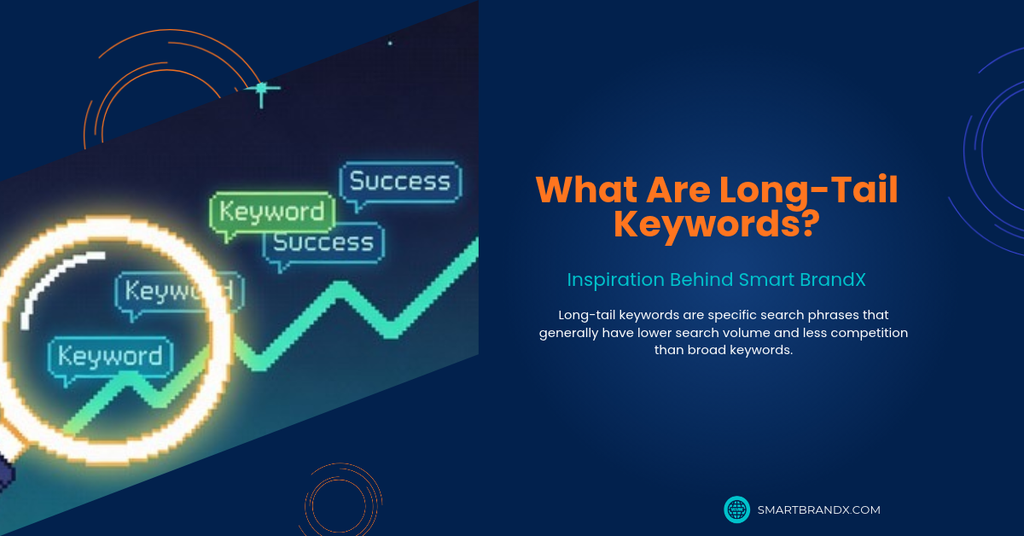
Long-tail keywords are specific search phrases that generally have lower search volume and less competition than broad keywords. They help search engines understand the exact subject of your content and connect it with users looking for particular information, products, or services.
For example, consider these searches:
Each phrase becomes more specific as it gets longer. The final example communicates a much clearer need than the first one.
Long-tail SEO keywords are not defined by word count alone. A phrase containing four words is not automatically a long-tail keyword. Its specificity, search intent, competition, and relationship to a broader topic also matter.
These keywords can serve different search intentions:
Although individual long-tail keywords may attract fewer searches, targeting a collection of relevant phrases can generate meaningful traffic over time.
The best approach is to understand what your audience wants, identify the language they use, and create content that provides a genuinely useful answer.
Keywords can be grouped into three general categories according to their breadth and specificity: short-tail, mid-tail, and long-tail keywords.
| Keyword type | Example | Typical characteristics |
| Short-tail | SEO | Broad topic, high competition, unclear intent |
| Mid-tail | SEO services for businesses | More focused, moderate specificity |
| Long-tail | Affordable SEO services for small businesses | Highly specific, clearer intent |
Short-tail keywords usually contain one or two words. They cover broad topics and often have high search volume. However, they can be difficult to rank for because many websites compete for them.
Example: Digital marketing
Mid-tail keywords are more specific than short-tail phrases but broader than highly focused long-tail searches. They can attract users who have started narrowing down their options.
Example: Digital marketing services for startups
Long-tail keywords target specific questions, needs, products, or services. They often have lower individual search volumes and may attract visitors with stronger intent.
Example: Affordable digital marketing services for technology startups
Which keyword type should you target?
A balanced SEO strategy can include all three. Short-tail keywords help establish broad topical relevance, mid-tail keywords connect related subjects, and long-tail keywords allow you to answer specific audience needs.
For newer websites, long-tail keywords can provide practical opportunities to build visibility before competing for broader search terms.
Long-tail keywords play an important role in modern SEO because they help businesses attract relevant visitors, understand search intent, and create content that answers specific questions.

Here are some major benefits:
Broad keywords are often targeted by established websites with strong authority and extensive backlink profiles. More specific keywords may have fewer competing pages, giving smaller websites opportunities to rank.
However, lower competition is not guaranteed. Always evaluate the actual search results before choosing a keyword.
Long-tail searches often reveal exactly what users want. Someone searching for “how to optimize product images for ecommerce SEO” has a more specific information need than someone searching for “SEO.”
Creating content that addresses this need can improve relevance and user satisfaction.
Not every website visitor becomes a customer. Long-tail SEO helps attract people searching for products, services, or solutions that closely match your business offerings.
For example, a user searching for “hire a technical SEO consultant for Shopify” may be closer to purchasing a service than someone searching for “SEO.”
Specific searches can indicate stronger buying intent. When your landing page matches the user’s requirements, you may improve the likelihood of generating leads, inquiries, or sales.
This is an opportunity, not a guaranteed conversion advantage.
Long-tail keywords help you discover new blog topics, FAQs, service pages, and supporting articles. They also help you build keyword clusters around important subjects.
People increasingly search using natural-language questions. Creating helpful content around specific questions can make your website more relevant to conversational searches and other evolving search experiences.
Ultimately, long-tail keywords help you focus on relevance rather than chasing traffic numbers alone.
Finding the right long-tail keywords requires understanding your audience, researching search behavior, and analyzing the opportunities available in your industry.
Here are nine practical methods to discover long-tail keyword ideas.
Keyword research tools can help you discover specific search phrases related to your main topic. Platforms such as Google Keyword Planner, Ahrefs, Semrush, and Ubersuggest provide keyword suggestions and metrics.
Start with a broad seed keyword, such as “content marketing.” Then explore related phrases, questions, keyword variations, search volume, and keyword difficulty.
Look for relevant opportunities such as:
Do not select keywords based on search volume alone. Consider relevance, intent, ranking difficulty, and your ability to create better content.
Google Autocomplete provides search suggestions as users type queries into the search box.
Enter your primary keyword and observe the suggested phrases. Try adding question words such as “how,” “what,” “why,” and “where.”
For example, typing “technical SEO” might reveal ideas related to technical SEO audits, website crawling, indexing, and site speed.
These suggestions can reveal common search patterns and help you discover content ideas.
Remember that autocomplete suggestions are not a complete keyword database. Treat them as research ideas and validate them before creating content.
Google’s People Also Ask section displays related questions that users may want answered.
Search for your main keyword and examine the questions appearing in the results.
For example, a search about long-tail keywords may reveal questions such as:
These questions can become FAQ sections, supporting blog topics, or headings within a comprehensive article.
Focus on answering each question accurately and avoid creating unnecessary pages for questions that share the same search intent.
Your existing keyword data can reveal long-tail opportunities that you may not be targeting intentionally.
Open Google Search Console and navigate to the Performance report. Review the Queries section to identify search phrases generating impressions and clicks.
Look for:
If a page receives impressions for a relevant long-tail phrase, consider improving its content to address that search more directly.
Competitor research helps you identify keyword opportunities that similar websites are already targeting.
Use SEO platforms such as Ahrefs or Semrush to analyze competing domains. Review their organic keyword reports and filter for longer, specific search phrases.
Look for relevant topics that your website has not covered or areas where your competitors provide incomplete answers.
Do not copy their content. Instead, identify the search intent, understand what users need, and create more useful resources with original examples and practical insights.
AI chatbots can help generate long-tail keyword ideas based on your industry, audience, products, and services.
For example, you can ask an AI chatbot:
“Generate 30 long-tail keywords for a digital marketing agency targeting small businesses. Include informational, commercial, and transactional search intent.”
You can also request keyword variations, question-based searches, and topic clusters.
However, AI-generated suggestions are brainstorming ideas, not verified keyword data. Validate them using keyword research tools, search results, and actual audience behavior.
Online communities are valuable sources of real customer language and questions.
Explore platforms such as Reddit, Quora, industry forums, Facebook groups, and relevant discussion communities.
Pay attention to:
For example, repeated discussions about improving a slow WordPress website could inspire keywords such as “how to improve WordPress website speed without a plugin.”
These insights can help you create content that addresses genuine audience problems.
Some highly specific searches show little or no estimated search volume in keyword research tools. These are often called zero-volume keywords.
That does not automatically mean nobody searches for them. Keyword databases may not capture every query, especially new, niche, or highly conversational searches.
Explore natural phrases such as:
Evaluate whether the question represents a genuine audience need. If it does, consider addressing it within a relevant page rather than creating a separate article for every variation.
Prompt research helps you discover the detailed questions people may ask AI assistants and conversational search tools.
Think about how your audience might describe a problem when speaking naturally. For example:
“I run a small online store. How can I get more organic traffic without spending too much on advertising?”
Break this prompt into potential topics:
You can also use AI tools to generate different audience scenarios and search questions.
Remember that prompts are useful research inputs, not proof of search volume or ranking demand. Validate promising ideas before investing in content production.
Finding long-tail keywords is only the first step. To achieve organic visibility, you need relevant content, strong on-page optimization, helpful information, and a logical website structure.
Here are seven effective ways to improve your chances of ranking.
Keyword clustering means grouping closely related keywords according to their topics and search intent.
For example, these phrases may belong to one content cluster:
Instead of creating four competing articles, you may be able to address these variations in one comprehensive resource.
Build a main pillar page around a broader topic and connect it with relevant supporting articles. This approach helps organize your website and develop topical coverage.
Before grouping keywords, review their search results and intent. Similar wording does not always mean the same intent.
Strategic keyword placement helps search engines and readers understand your page.
Include your primary long-tail keyword naturally in important locations, such as:
You do not need to force the exact phrase into every section. Use relevant variations and related terminology to maintain natural readability.
Search engines aim to provide users with useful, relevant results. Your content should solve the problem behind the keyword rather than simply repeat the search phrase.
For example, an article targeting “how to find long-tail keywords for ecommerce” should explain practical research methods, provide ecommerce-specific examples, and help readers choose relevant terms.
Demonstrate experience through original examples, screenshots where useful, practical recommendations, and clear explanations.
Provide accurate information, cite trustworthy sources when appropriate, and keep content updated when important details change.
Keyword stuffing can make content difficult to read and does not create a good user experience.
Use your primary keyword where it makes sense, then include natural variations, related concepts, and question-based phrases.
For example, an article targeting “SEO for small businesses” may naturally discuss local search optimization, website visibility, keyword research, organic traffic, and on-page SEO.
The goal is to cover the subject comprehensively rather than repeat the same phrase unnecessarily.
For ecommerce websites, filter pages can help users find products based on specific characteristics such as size, color, price, brand, or category.
For example, a clothing store might offer a useful category page for “black running shoes for women.”
However, creating indexable pages for every possible filter combination can generate duplicate or thin content.
Only make filter or category pages indexable when they serve a meaningful search demand and provide distinct value. Use appropriate canonical tags, crawl controls, and indexing rules to manage duplicate URLs.
Structured data helps search engines understand the information on your pages.
Depending on the content, relevant schema types may include:
For example, Product structured data can describe product details, while BreadcrumbList can help explain a page’s position within your website hierarchy.
Implement valid, accurate structured data that matches visible page content and follows Google’s guidelines.
Schema markup does not guarantee rich results or higher rankings, but it can help search engines interpret your content.
Internal links connect related pages within your website and help users discover additional information.
Suppose you publish an article about long-tail SEO. You can link naturally to related resources about keyword research, on-page SEO, technical SEO, and content marketing.
Use descriptive anchor text that explains what readers will find after clicking.
Avoid linking every keyword to the same page. Prioritize contextual relevance and a logical site structure.
A strong internal linking strategy can help search engines discover important pages while encouraging visitors to explore more of your website.
Long-tail keywords are valuable in pay-per-click (PPC) advertising because they can help advertisers reach people searching for specific products, services, and solutions.
Unlike broad keywords, specific search phrases often communicate clearer expectations. This can help you build more focused campaigns and create ads that closely match what users want.
Follow these steps to find long-tail keywords for PPC campaigns.
List your main products, services, and customer problems. Turn each item into specific search phrases.
For example, an SEO agency could target:
Google Keyword Planner can help you discover keyword ideas, review estimated search volumes, and understand advertising competition.
Enter your product or service and explore more specific variations.
Separate keywords according to what users want to accomplish.
For example:
For campaigns focused on leads or sales, prioritize queries that closely match your conversion goals.
After launching a campaign, monitor the Search Terms report to understand the queries that triggered your ads.
Identify relevant long-tail searches that deserve dedicated ad groups. Add irrelevant searches as negative keywords when appropriate.
Create focused ads and landing pages that reflect the searcher’s needs.
For example, someone searching for “affordable Google Ads management for small businesses” should land on a page explaining your relevant service, pricing approach, benefits, and next steps.
Finally, evaluate conversions, cost per conversion, and return on ad spend—not just clicks or impressions.
Long-tail keywords exist across almost every industry. Their value depends on how closely they match your audience, products, and services.
Here are examples from different niches.
| Industry | Broad keyword | Long-tail keyword |
| SEO | SEO | How to improve SEO for a new business website |
| Digital marketing | Digital marketing | Affordable digital marketing strategies for startups |
| Ecommerce | Running shoes | Best running shoes for beginners with flat feet |
| Fitness | Weight loss | Beginner-friendly home workouts without equipment |
| Technology | Laptops | Best lightweight laptops for remote work under $1,000 |
| Education | Online courses | Best online digital marketing courses for beginners |
| Travel | Hotels | Affordable family-friendly hotels near central London |
| Finance | Budgeting | How to create a monthly budget with an irregular income |
| Real estate | Apartments | Affordable two-bedroom apartments near public transport |
| Food | Healthy meals | Easy high-protein vegetarian meals for busy professionals |
If you operate a digital marketing or SEO website, consider researching phrases such as:
These examples are starting points, not verified keyword opportunities. Check their relevance, competition, search results, and available keyword data before targeting them.
The strongest long-tail SEO keywords are the ones that connect your content with a genuine audience need.
Tracking long-tail keyword rankings helps you understand whether your SEO strategy is improving your website’s visibility and attracting relevant organic traffic.
However, ranking position is only one part of SEO performance. You should also monitor impressions, clicks, engagement, and conversions.
Here is how to track your progress.
Google Search Console is a useful starting point for monitoring organic search performance.
Open the Performance report and review:
Filter the report by a specific page to identify the long-tail queries generating impressions and clicks for that URL.
Platforms such as Ahrefs, Semrush, and other rank-tracking tools can help you monitor selected keywords over time.
Create a keyword list containing your target long-tail phrases. Track ranking changes, competing pages, and visibility trends.
Keep in mind that rankings can vary by location, device, personalization, and tracking methodology.
Use Google Analytics 4 to evaluate organic landing-page traffic and user behavior.
Identify which pages attract organic visitors and whether those visitors complete meaningful actions, such as submitting a contact form, purchasing a product, or requesting a consultation.
A keyword that attracts fewer visitors may still contribute valuable leads or sales.
Track conversion events and connect them with landing-page performance to understand which content supports business objectives.
Compare performance over consistent periods, investigate significant changes, and update pages when they no longer satisfy search intent.
At Smart Brand X, we recommend combining ranking data with real business outcomes. The objective is not simply to rank for more keywords; it is to attract the right audience and turn organic visibility into measurable growth.
Long-tail SEO is one of the most practical ways to build relevant organic visibility, especially when your website is competing against established brands and highly authoritative domains.
Instead of focusing entirely on broad keywords, long-tail SEO encourages you to understand what your audience actually searches for. Specific queries reveal customer problems, questions, preferences, and buying intentions. This information can guide your keyword research, content strategy, landing pages, and overall website structure.
Start by researching relevant long-tail keywords through SEO tools, Google Autocomplete, People Also Ask, competitor analysis, online communities, and your existing Search Console data. Then organize related phrases into keyword clusters and create helpful content that satisfies the underlying search intent.
Remember that ranking success requires more than inserting keywords into headings. Strong content quality, accurate information, internal linking, technical SEO, and a positive user experience all contribute to a sustainable SEO strategy.
You do not need thousands of visitors to build a successful website. You need the right visitors who are genuinely interested in what you offer.
At Smart Brand X, our focus is on helping businesses strengthen their online presence through strategic SEO, valuable content, and audience-focused digital marketing. Start targeting the searches that matter, create content that deserves attention, and turn long-tail opportunities into long-term growth.
Long-tail SEO focuses on optimizing website content for specific, highly targeted search phrases. It helps businesses attract relevant visitors by addressing detailed search queries and user intentions.
An example is “best affordable SEO services for small businesses.” This phrase targets a specific audience with a clear need, making it more focused than broad keywords.
Long-tail keywords can be easier to rank for because they often have less competition. However, ranking difficulty depends on search intent, content quality, and competitor strength.
Long-tail keywords often contain three or more words, but word count does not define them. Their specificity, search intent, and competition matter more than length.
Use keyword research tools, Google Autocomplete, People Also Ask, competitor analysis, Search Console, online communities, and AI chatbots to discover relevant long-tail keyword opportunities.
Long-tail keywords can attract visitors with specific needs and stronger buying intent. Relevant landing pages may turn this targeted traffic into more qualified leads or sales.
Ranking timelines vary depending on website authority, competition, content quality, and technical SEO. Some pages gain visibility within weeks, while others require several months of improvement.
SEO Basics 101 is your complete guide to search engine optimization, designed to help you improve organic visibility,...
Read MoreSearch has changed dramatically. Google AI Overviews, conversational search, and generative engines are transforming how users discover information....
Read MoreFor more than a decade, marketers have repeatedly claimed that SEO is dead in 2026. Every major Google...
Read More