SEO
SEO Basics 101: The 8 Most Powerful Fundamentals for Dominating Search in 2027
SEO Basics 101 is your complete guide to search engine optimization, designed to help you improve organic visibility,...
Read More
SEO is constantly evolving. Search engines are becoming smarter, user expectations are increasing, and AI-powered search experiences are changing how people discover information online. Simply targeting a few keywords, publishing blog posts, and building backlinks is no longer enough to achieve sustainable organic growth.
Businesses need a more strategic approach that combines technical SEO, Advanced SEO strategies, content optimization, search intent, user experience, and authority building.
Advanced SEO strategies focus on improving every part of a website’s organic search performance. From identifying valuable long-tail keywords and fixing technical issues to refreshing outdated content and earning high-quality backlinks, every activity should contribute to a measurable goal.
The real purpose of SEO is not just to increase rankings. It is to attract the right audience, answer their questions, build trust, and turn organic visitors into potential customers.
Whether you are an SEO professional, business owner, content marketer, or beginner looking to take your optimization skills to the next level, implementing the right strategies can make a significant difference.
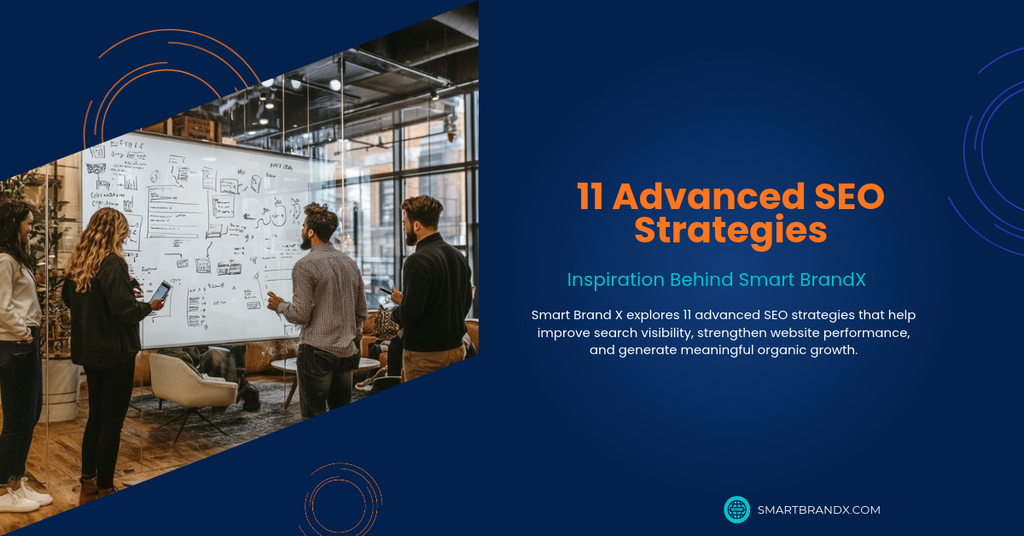
In this guide, Smart Brand X explores 11 advanced SEO strategies that help improve search visibility, strengthen website performance, and generate meaningful organic growth.
Successful Advanced SEO strategies start with understanding what your audience is searching for. Instead of randomly selecting keywords for individual blog posts, create a master list of topics supported by relevant long-tail keywords. This approach helps you build a structured content strategy that addresses different stages of the customer journey.
Begin by identifying the main subjects related to your industry, products, services, and audience interests. These subjects will become your primary content pillars. Next, expand each topic into smaller subtopics using keyword research tools, Google autocomplete, Google Search Console, competitor analysis, and People Also Ask questions.
For example, a digital marketing website might target a broad topic such as SEO. Its supporting long-tail keywords could include:
These specific search queries often reveal clearer user intent than broad keywords.
Organize your keywords according to search intent, including informational, navigational, commercial, and transactional intent. Then map each keyword to the most appropriate existing or planned page.
A master keyword database also helps prevent duplicate content and keyword cannibalization.
At Smart Brand X, we recommend treating keyword research as an ongoing process rather than a one-time activity. Regularly review search trends, ranking opportunities, and audience questions to keep your content strategy relevant and competitive.
Technical SEO creates the foundation that allows search engines to discover, crawl, understand, and index your website. Even excellent content may struggle to perform if search engines encounter crawling problems, broken links, poor page performance, or incorrect indexing signals.
One of the most effective advanced SEO strategies is building a comprehensive technical SEO checklist and updating it regularly.
Start with the fundamentals. Check your XML sitemap, robots.txt file, canonical tags, HTTPS implementation, internal linking structure, and indexability settings. Make sure important pages are accessible to search engine crawlers and that unnecessary or duplicate URLs are not wasting crawl resources.
Your checklist should also cover website performance and user experience.
Important technical SEO areas include:
Use Google Search Console, PageSpeed Insights, and website crawling tools to identify technical problems.
However, do not treat your checklist as a document you complete once and forget. Websites change whenever developers publish updates, install plugins, modify templates, or introduce new pages.
Review your technical SEO performance regularly. Prioritize issues based on their impact on crawling, indexing, usability, and organic visibility.
A technically healthy website gives your content a stronger opportunity to compete in search results.
Google’s People Also Ask (PAA) section is an excellent resource for discovering the questions your target audience wants answered. It provides valuable insights into search intent and helps SEO professionals identify content opportunities that traditional keyword research may overlook.
Instead of focusing exclusively on high-volume keywords, explore the questions that appear when users search for your primary topics.
For example, searching for “advanced SEO strategies” may reveal related questions such as:
These questions can become supporting sections, detailed blog posts, FAQ content, or ideas for an entire topic cluster.
To use PAA effectively, start by searching your primary keyword in Google. Record relevant questions, explore related questions, and identify recurring themes. You can also compare PAA results across different keyword variations to discover additional search opportunities.
The next step is understanding the intent behind each question. Some users want quick explanations, while others need detailed tutorials, comparisons, or step-by-step instructions.
Create content that directly answers these questions without unnecessary introductions or repetitive information.
You can also use PAA insights to strengthen existing articles by adding relevant explanations and helpful FAQ sections.
Remember, including a question does not guarantee a featured snippet or PAA placement. Your goal should be to provide the clearest and most useful answer.
When combined with keyword research and competitor analysis, People Also Ask can help you build a more comprehensive content strategy that addresses real user needs.
Time to value refers to how quickly visitors receive useful information after landing on your website. In SEO, this concept is particularly important because people generally want answers without navigating through unnecessary introductions, repetitive explanations, or irrelevant information.
Imagine someone searching for “how to fix a broken internal link.” They probably want to understand the problem and find a practical solution immediately. If your article contains several paragraphs of unrelated background information before explaining the solution, visitors may become frustrated.
Improving time to value means delivering meaningful information as early as possible.
Start by understanding the primary search intent behind your target keyword. Then structure your introduction to explain what the reader will learn and why the information matters.
Use descriptive headings, short paragraphs, relevant examples, and actionable recommendations. Place important explanations near the beginning instead of hiding them deep inside the article.
Here are several ways to improve content accessibility:
However, improving time to value does not mean making every article extremely short. Comprehensive topics still require detailed explanations, supporting evidence, and context.
The objective is to help readers reach useful information quickly while providing enough depth to solve their problems.
At Smart Brand X, a reader-focused content strategy should prioritize clarity, relevance, and practical value rather than unnecessary word count.
Publishing new content is important, but maintaining existing content is equally valuable. Over time, information becomes outdated, competitors publish stronger resources, search intent changes, and previously successful pages may experience ranking declines.
A content reoptimization schedule helps you identify these opportunities before valuable pages lose more organic visibility.
Start by reviewing your website’s existing content inventory. Use Google Search Console and Google Analytics 4 to evaluate organic impressions, clicks, traffic trends, and engagement-related metrics.
Look for pages that:
Once you identify these pages, prioritize updates according to their business value and improvement potential.
Reoptimization may involve improving title tags, rewriting outdated sections, adding relevant long-tail keywords, strengthening internal links, improving readability, and including original examples.
For example, an article about SEO trends published several years ago may need updated information about AI-powered search, changing search experiences, and current optimization practices.
However, avoid changing content simply to make it look fresh. Every update should improve accuracy, usefulness, relevance, or user experience.
Create a monthly or quarterly review schedule based on your publishing volume and industry changes. Record the original performance, changes made, and results after updating.
A systematic content refresh strategy helps protect existing organic traffic while creating new opportunities to improve search performance.
Original images are an often-overlooked part of effective Advanced SEO strategies. Many websites rely heavily on generic stock photography, even when custom visuals could explain their topics more effectively and make their content more memorable.
Creating original images gives your website an opportunity to provide additional value through visual explanations, screenshots, diagrams, infographics, product demonstrations, and data visualizations.
For example, an article explaining technical SEO could include an original diagram showing how search engine crawling, indexing, and ranking work together. Similarly, a keyword research tutorial could include screenshots demonstrating how to identify keyword opportunities using Google Search Console.
These visuals make complex information easier to understand.
Original images can also support your website’s visual identity and help differentiate your content from competing resources.
For image SEO, follow these best practices:
Avoid adding keywords unnaturally to image file names or alt text. Alternative text should describe the image’s purpose and content, particularly for users relying on screen readers.
You can also use original visual assets in social media campaigns, newsletters, and other marketing channels.
Remember, original images do not automatically improve rankings. Their value comes from making content more useful, accessible, engaging, and distinctive.
A thoughtful visual content strategy can strengthen the overall quality of your website.
URL parameters are additional elements added to a web address, usually after a question mark. They often help websites track marketing campaigns, filter products, sort search results, or manage dynamic page experiences.
For example:
example.com/products?category=shoes
Although URL parameters are useful for website functionality, they can create SEO challenges when multiple URL variations display identical or substantially similar content.
For large websites, particularly e-commerce platforms, poorly managed parameters may generate thousands of unnecessary URL variations. This can complicate crawling, create duplicate content concerns, and make it harder for search engines to identify the preferred version of a page.
Start by identifying the URL parameters your website uses. Common examples include:
Next, determine whether each parameter creates a genuinely valuable page or simply changes how an existing page is displayed.
Use appropriate canonical tags when multiple URLs contain substantially similar content and a preferred version exists. Ensure internal links consistently point to your preferred URLs.
Where appropriate, use robots.txt directives or other crawl-management techniques carefully. Remember that blocking a URL from crawling does not guarantee that it will be removed from Google’s index.
Avoid creating unnecessary indexable combinations of filters and sorting options. For websites with complex URL structures, coordinate with developers to establish consistent parameter handling.
Google Search Central documentation should guide technical implementation because different parameter configurations require different solutions.
Effective URL parameter management helps maintain a cleaner website architecture and allows search engines to focus on your most valuable pages.
Keyword cannibalization occurs when multiple pages on the same website target the same or very similar search queries and compete for visibility. Although having several relevant pages is not automatically a problem, overlapping content can create confusion about which page best satisfies a particular search intent.
For example, imagine publishing three separate articles targeting:
If all three articles provide nearly identical information and target the same audience, they may overlap unnecessarily.
This can divide backlinks, internal link signals, and organic performance across multiple URLs.
To identify potential keyword cannibalization, review Google Search Console’s Performance report. Filter by a target query and examine which pages receive impressions and clicks for that keyword.
You can also use SEO crawling and keyword tracking tools to identify overlapping keyword targets.
Once you discover an issue, evaluate the purpose and quality of each page.
Possible solutions include:
Do not automatically delete pages simply because they rank for similar keywords. First, determine whether they serve different search intents.
A well-organized website should have a clear purpose for every important page.
Reducing unnecessary content overlap helps strengthen topical organization and makes your overall Advanced SEO strategies more efficient.
Building high-quality backlinks remains an important part of developing website authority and improving online visibility. One practical link-building opportunity is discovering websites that mention your brand without linking to your website.
These references are called unlinked brand mentions.
For example, another website might publish an article discussing Smart Brand X, mention its SEO services, or reference one of its resources without including a clickable link.
That mention already demonstrates some level of brand recognition. With a professional outreach approach, you may be able to turn it into a relevant backlink.
Start by monitoring your brand name, website name, founder name, and important branded terms.
You can use tools such as Google Search, Google Alerts, Ahrefs, and Semrush to discover potential mentions.
Search variations such as:
Once you find a relevant mention, check whether it already links to your website. If not, identify the page owner or editor and send a short, personalized outreach message.
Explain where your brand is mentioned and politely ask whether they would consider linking to your relevant website page.
Avoid demanding backlinks or offering payment for followed links. Focus on relevance, editorial value, and genuine relationships.
Also, evaluate the quality of the referring website. A relevant, trustworthy mention is generally more valuable than a link from an unrelated or low-quality website.
Unlinked brand mentions can turn existing brand awareness into additional referral opportunities and help strengthen your website’s online presence.
One of the biggest SEO mistakes is creating content primarily to satisfy search engine algorithms rather than helping real people.
Search engines aim to deliver useful and relevant information. Therefore, content that focuses excessively on keyword placement, repetitive phrases, and artificial word counts may fail to satisfy the audience it is supposed to attract.
Modern SEO requires a user-first approach.
Start by understanding why someone searches for a particular keyword. Are they looking for a definition, a practical tutorial, a product comparison, or a professional service?
Your content should address that need directly.
For example, if someone searches for “how to improve website SEO,” simply repeating the phrase throughout an article will not provide much value. Readers need actionable techniques, realistic examples, useful tools, and clear explanations.
Follow these principles when creating people-first content:
Google’s people-first content guidance emphasizes creating content that provides a satisfying experience for visitors.
This also connects directly with E-E-A-T:
Experience, Expertise, Authoritativeness, and Trustworthiness.
Demonstrate real knowledge, explain your recommendations, provide accurate information, and make it easy for readers to understand who created your content.
At Smart Brand X, the objective should always be to create content that deserves attention because it solves problems, not simply because it contains keywords.
Not every article you publish will generate organic traffic, attract backlinks, or produce conversions. Some pages may struggle because they target the wrong keywords, provide outdated information, lack sufficient depth, or fail to match user intent.
Advanced SEO strategies require understanding when to improve existing content and when to remove unnecessary pages.
Start by auditing your website to identify underperforming URLs. Evaluate their organic clicks, impressions, rankings, backlinks, conversions, content quality, and internal links.
However, avoid judging a page solely by its traffic. Some pages may generate few visitors but still provide valuable information, support customer decisions, or contribute to conversions.
After evaluating a page, choose the most appropriate action.
Before removing anything, review backlinks, internal links, traffic history, and business importance. Do not automatically delete pages simply because they receive little organic traffic.
Content pruning should be based on evidence rather than assumptions.
Regular content audits help maintain website quality, reduce unnecessary duplication, and direct resources toward pages with greater potential.
The goal is not to publish more content. It is to maintain a website where every important page serves a clear purpose.
Achieving consistent organic growth requires much more than publishing articles and targeting competitive keywords. Successful Advanced SEO strategies involve building a complete strategy that connects keyword research, technical optimization, content quality, website architecture, link building, and user experience.
The 11 advanced SEO strategies discussed in this guide provide a practical framework for improving your website’s search performance.
Start by creating a master keyword list and organizing your content around relevant topics. Strengthen your technical SEO foundation, explore People Also Ask opportunities, and deliver useful information quickly. Regularly refresh existing articles, create original visuals, and manage URL parameters carefully.
At the same time, address keyword cannibalization, discover unlinked brand mentions, and prioritize people-first content. Finally, evaluate underperforming pages and make data-driven decisions about improving, consolidating, redirecting, or removing them.
Remember that SEO is a long-term process. Rankings, traffic, and conversions do not improve overnight. Consistent implementation, accurate measurement, and continuous optimization are essential for sustainable results.
At Smart Brand X, we believe effective Advanced SEO strategies are about building a strong online presence that delivers real value to both businesses and their audiences.
Whether you manage a personal blog, an e-commerce store, or a growing business website, the right SEO strategy can help you attract qualified visitors, establish credibility, and create long-term growth opportunities.
Focus on helping people first, optimize strategically, and let sustainable organic growth follow.
Explore more SEO insights, digital marketing strategies, and practical optimization guides at Smart Brand X Blogs.
Advanced SEO strategies are techniques that improve website visibility, organic traffic, and search rankings through technical optimization, keyword research, content improvements, and authoritative link building.
They help websites target relevant keywords, satisfy search intent, improve technical performance, strengthen content quality, and attract qualified visitors through organic search results.
Technical SEO improves website crawling, indexing, speed, mobile usability, and overall structure, helping search engines understand and access important website pages.
Review important content every three to six months, or sooner when rankings decline, information becomes outdated, search intent changes, or new opportunities emerge.
Long-tail keywords target specific search queries, attract more relevant visitors, face less competition in many cases, and help websites address precise user needs.
Keyword cannibalization happens when multiple pages compete for similar search queries. Prevent it through keyword mapping, content consolidation, and clearly differentiated search intent.
SEO results vary depending on competition, website authority, technical health, and implementation. Meaningful improvements often take several months of consistent optimization and monitoring.
SEO Basics 101 is your complete guide to search engine optimization, designed to help you improve organic visibility,...
Read MoreLong-tail SEO is optimizing your website content for specific, focused search queries instead of targeting only broad, highly...
Read MoreSearch has changed dramatically. Google AI Overviews, conversational search, and generative engines are transforming how users discover information....
Read More